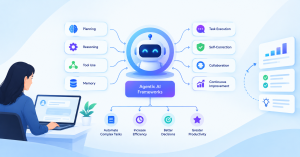
Agentic AI is moving fast from experiments to real systems that take actions in production. Unlike a plain large language model (LLM) that only generates text, an agentic system wraps the model with planning, tool use, reflection, and sometimes multiple collaborating agents so it can iterate toward a goal and produce business outcomes. Because these systems can behave in nondeterministic ways, they introduce a “prototype to production” gap that is wider than in traditional software: a demo that looks stable in a controlled setting may not hold up when exposed to real users, messy inputs, and changing operational contexts.
A production-minded approach starts with deciding where agentic reasoning truly belongs. The playbook emphasizes that teams should not try to make everything agentic because deterministic code is typically cheaper, faster, and more reliable when rules are clear. A practical way to make this decision is to map workflows and identify the steps that require judgment under ambiguity (good candidates for LLM reasoning) versus steps that can be expressed as fixed rules or straightforward automation (better implemented deterministically). This analysis can be made concrete using a capability-matrix style breakdown, where each workflow step is split into deterministic components and agentic components, making the boundary explicit and testable.
Once the “where” is clear, the next decision is “how” to orchestrate agent behavior. Common architecture patterns cover many real-world needs, including iterative loops where the agent reasons, acts via tools, observes results, and repeats until a stop condition is met (often associated with ReAct-style loops). For larger problems, teams can introduce a supervisor approach where one planning agent delegates work to specialized agents, and can further expand into hierarchical structures when coordination becomes complex. Many production workflows also benefit from human-in-the-loop checkpoints, where the system pauses for approval at sensitive decision points to reduce risk and improve accountability.
A key shift in agentic development is that prompts and related artifacts are production assets, not informal notes. The playbook calls out the need to version and manage system prompts, tool manifests, policy configurations, memory schemas, and evaluation datasets with the same discipline used for infrastructure-as-code and release governance. This is partly because small prompt changes can lead to behavioral drift, and that drift can surface as reliability issues in production. Treating prompts and policies like deployable artifacts enables teams to apply semantic diffs, formal approvals, and rollbacks, which reduces the chance that “harmless” edits turn into incidents.
Testing also needs to evolve because success is often behavioral rather than a single fixed output. The playbook frames agentic systems as having deterministic “shell” components, an orchestration layer that assembles runtime context, and an inference core that behaves like a black box influenced by prompts and state. In practice, this pushes teams toward approaches such as property-based testing, scenario-based harnesses, and metamorphic testing, where validation focuses on whether outcomes satisfy constraints and relationships rather than matching one exact string. The article also highlights “golden trajectories” as a useful regression concept: capturing validated traces of tool calls and decision paths so changes can be compared against known-good behavior.
Finally, production operations matter as much as development. Agentic systems benefit from strong tracing of model calls, tool calls, and decision points so teams can debug, audit, and understand failure modes in nondeterministic flows. With these practices—scoping agentic work carefully, choosing proven orchestration patterns, versioning artifacts rigorously, and adopting behavior-focused testing—teams can turn promising prompt-based prototypes into dependable, governable systems that scale.
Read more such articles from our Newsletter here.