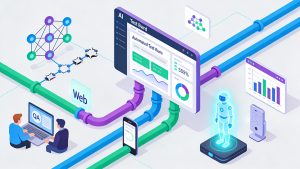
Antigravity is Google’s new agentic development platform, launched in late 2025 alongside the Gemini 3 model, and designed to function more like an autonomous team of junior developers than a traditional code assistant. It runs specialized agents across the editor, terminal, and browser, allowing them to plan and execute multi-step development workflows while validating their own output.
Antigravity as an Agent-First Coding Platform
Unlike single-model autocomplete tools, Antigravity coordinates multiple agents that specialize in tasks like backend logic, UI implementation, debugging, optimization, and security hardening. These agents can decompose a feature request into subtasks, execute them in parallel, and then integrate the components into a coherent application or service. For developers, this moves AI from “assistive autocomplete” to an always-on collaborator embedded across the full software lifecycle.
Multi-Agent Parallelism in Practice
In practical workflows, Antigravity can take a high-level requirement, design a plan, generate the codebase, run tests, and verify functionality through browser-based computer use. The system leverages agents with direct access to terminals and development tools, allowing them to spin up services, inspect logs, and iterate until acceptance tests pass. This capability makes it particularly powerful for scenarios like building prototypes, scaffolded applications, or feature branches under tight deadlines.
Gemini 3: The Intelligence Behind Antigravity
Gemini 3 is described by Google as its most intelligent model family to date, offering state-of-the-art reasoning and agentic coding capabilities that underpin Antigravity’s performance. With a standard context window of up to one million tokens in Gemini 3 Pro, the model can keep entire repositories, long specifications, and complex architectural discussions in active memory while coordinating agent behavior.
Advanced Reasoning, Context, and Tool Use
Gemini 3 brings stronger instruction-following, better tool use, and improved multimodal understanding, enabling agents to work from code, documentation, UI mocks, or logs in a single workspace. This lets Antigravity evaluate alternative implementations, refactor large files, and reason about cross-cutting concerns like performance and security within one continuous context. Benchmarks show Gemini 3 Pro leading in several coding and reasoning evaluations, reinforcing its suitability for agent-first development platforms.
Productivity Gains and Developer Experience
Early feedback from the ecosystem highlights Antigravity’s ability to reduce boilerplate work, automate repetitive tasks, and shorten development cycles for teams and solo developers alike. By offloading test creation, scaffolding, and routine refactors to agents, developers can concentrate on system design, domain modeling, and strategic decision-making.
Integration with Cloud and Existing Toolchains
Antigravity is accessible via Google’s broader stack, working alongside tools like Gemini CLI and Vertex AI, and integrating into CI/CD workflows for automated reviews and deployments. The platform is available in public preview across major desktop operating systems and offers generous access to Gemini 3 Pro for individuals.
Job Displacement Concerns and New Roles
Because Antigravity can perform many tasks historically assigned to entry-level engineers—such as boilerplate coding, basic testing, and environment setup—commentators have raised concerns about its impact on junior developer opportunities. Some analyses suggest that generative AI is already eroding entry-level roles in software, even as it boosts productivity for experienced professionals.
Augmentation Over Replacement
Industry voices and Google’s own messaging emphasize that human developers remain essential to define goals, interpret requirements, and supervise AI-driven workflows. Rather than eliminating junior roles entirely, Antigravity is likely to shift expectations toward managing agents, understanding complex systems, and validating AI-produced code.
Ethical, Security, and IP Considerations
As multi-agent systems generate large volumes of code, questions arise around intellectual property, training data, and potential replication of proprietary patterns. Google points to safeguards across its AI ecosystem, including watermarking of AI-generated content and a focus on responsible use, but experts continue to call for greater transparency and robust governance. Security remains critical, with organizations expected to apply strict access controls, monitoring, and encryption when agents operate in production environments.
Competitive Landscape and Future Outlook
Antigravity enters a crowded market of AI coding tools from OpenAI, Anthropic, and various IDE-native assistants, but differentiates itself through deep integration with Gemini 3 and an explicit agent-first design. Enterprise commentators note that requiring less prompting, supporting large contexts, and providing verifiable agent artifacts could give it an advantage in complex, regulated environments.
Toward Mainstream Agentic Development
With public preview already live and codelabs guiding developers through installation and usage, Antigravity is positioned to become a standard part of modern development workflows. If adoption trends continue, agentic platforms backed by models like Gemini 3 may become as fundamental as version control, reshaping how software is conceived, built, and maintained over the next few years.
Read more such articles from our Newsletter here.