
Modern distributed systems, especially microservices, tend to have inevitable failures. Services communicate over unreliable networks, dependencies may slow down, and external APIs can become temporarily unavailable. Without proper safeguards, these failures can cascade across the system and bring down entire applications.
The Circuit Breaker Pattern is a powerful resilience mechanism that prevents such cascading failures. It ensures system stability by detecting faults, stopping repetitive request attempts, and allowing services to recover gracefully.
In this article, we explore what the circuit breaker design pattern is, how it works, key internal states, its role in microservices, popular libraries like Resilience4j and Netflix Hystrix, best practices, and common pitfalls to avoid.
What Is the Circuit Breaker Pattern?
The Circuit Breaker Pattern is a design pattern used to detect failures and encapsulate logic to prevent a system from trying to execute an operation that is likely to fail.
Inspired by electrical circuit breakers, this software pattern:
- Monitors interactions with external dependencies
- Stops unnecessary repeated attempts when a dependency is failing
- Helps systems remain responsive
- Provides automatic recovery pathways
Why is Circuit Breaker Needed?
In a microservices environment, repeated failures such as:
- High-latency calls
- Timeout errors
- External service downtime can pile up and consume system resources.
The circuit breaker prevents this by breaking the connection until the dependency becomes healthy again.
How the Circuit Breaker Design Pattern Works
One or more microservices may become unavailable or show high latency when they work together to handle requests. When microservices are used in complicated applications, a single microservice outage can cause the application to fail. Remote procedure calls are used by microservices to interact, and failures could result from temporary network connectivity issues. (The retry with backoff technique can be used to address the transitory errors.) During synchronous execution, the cascading of timeouts or errors can cause a poor user experience.
A circuit breaker wraps calls to external services or remote dependencies.
Here’s the typical behavior:
- The application attempts a request to an external service.
- The circuit breaker tracks the success and failure rates.
- Once failures exceed a predefined threshold, the circuit breaker “opens.”
- Subsequent requests fail immediately without calling the external service.
- After a timeout, the circuit breaker transitions to a half-open state to test recovery.
This mechanism avoids:
- Overloading already-failing services
- Wasting resources on doomed requests
- Causing cascading failures across microservices
Key States of a Circuit Breaker: Closed, Open, and Half-Open
The circuit breaker has three primary states.
1. Flow A: Closed State
- Normal functioning
- All requests go through to the remote service
- Failures are tracked via counters
If failures exceed the threshold → move to OPEN
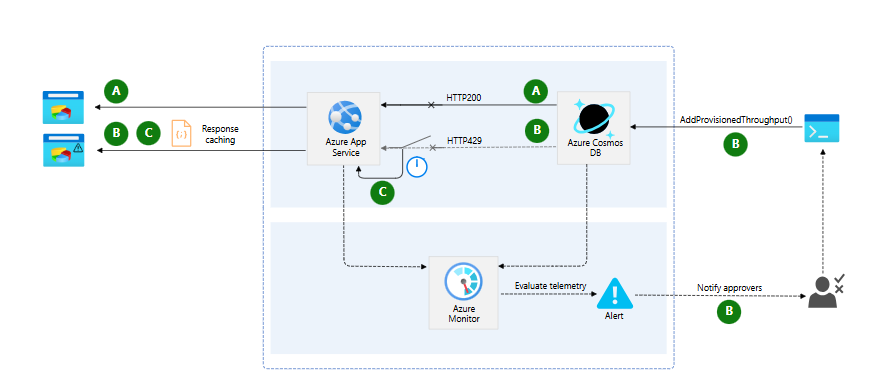
2. Flow B: Open State
- The circuit is “broken.”
- All requests fail instantly
- Prevents new requests from overwhelming the failing dependency
After the wait timeout → move to HALF-OPEN
3. Flow C: Half-Open State
After a predefined time-out, the circuit breaker enters a Half-Open state that permits a limited number of trial requests. If these trial requests succeed without returning 429 responses, the breaker resets to a Closed state, and normal operations return to Flow A.
- Test state to check if the dependency has recovered
- Allows a limited number of test requests
If tests succeed → move to CLOSED
If tests fail → revert to OPEN
State Transition Summary
| State | Behavior | Purpose |
| Closed | All calls allowed | Normal operation |
| Open | All calls rejected | Protect the system & dependency |
| Half-Open | Limited calls allowed | Recovery testing |
This flow ensures reliable and self-healing communication between services.
Benefits of Implementing the Circuit Breaker Pattern
Smart circuit breakers are packed with innovative safety measures to properly protect your electrical system. These devices guarantee reliable circuit protection, preventing overloads and short circuits, while also protecting against undervoltage, a critical factor in maintaining a safe electrical environment.
The Circuit Breaker Pattern helps microservices stay resilient, stable, and responsive even when dependencies fail. Here are the major benefits:
1. Prevents Cascading Failures
When one downstream service becomes slow or fails, it can cause a chain reaction that crashes multiple services. A circuit breaker stops this by cutting off requests to the failing service, preventing a total system breakdown.
2. Improves System Resilience
By detecting failures early and isolating faulty components, the system stays functional even when some services go down. This ensures higher fault tolerance and better overall reliability.
3. Enhances Application Performance
Instead of waiting for slow timeouts or repeated retries, a circuit breaker fails fast when a service is unavailable.
This reduces:
- Thread blocking
- Request queuing
- Response latency
As a result, the entire system stays snappy and responsive.
4. Enables Quick Recovery
Circuit breakers periodically allow a limited number of test requests in the Half-Open state to check whether the failing service has recovered.
If successful, the circuit closes automatically. This helps services self-heal without manual intervention.
5. Protects Resources from Getting Overloaded
Without a circuit breaker, services may keep retrying failed operations, causing:
- CPU spikes
- Thread exhaustion
- Connection pool exhaustion
- Database overload
A circuit breaker stops unnecessary retries, protecting critical resources.
6. Provides Better User Experience
Instead of users waiting forever for a response, the application returns a quick fallback – such as:
- Cached data
- Default values
- Friendly error messages
This ensures a smoother experience during partial failures.
7. Helps in Monitoring and Failure Detection
Circuit breakers expose valuable metrics like:
- Failure rate
- Timeout rate
- Open/closed state transitions
- Retry attempts
These insights help teams detect issues faster and improve observability.
8. Supports Graceful Degradation
Rather than crashing completely, applications can degrade functionality gracefully when a dependency fails. For example:
- Disable non-critical features
- Show partial data
- Switch to a backup service
This maintains continuity of service during failures.
9. Reduces Timeout Hell in Distributed Systems
In microservices, long timeouts can pile up and block threads. Circuit breakers prevent this by cutting failures early, reducing timeout chains, and improving throughput.
10. Integrates Easily with Modern Tools
Libraries like Resilience4j, Hystrix, and Spring Cloud provide production-ready implementations, making it easy to adopt circuit breakers in any Java or microservices ecosystem.
Circuit Breaker Pattern in Microservices Architecture
In microservices, each service typically depends on multiple others:
- Payment depends on the wallet service
- Order depends on the inventory service
- An API gateway calls many downstream services
If any downstream service becomes slow or fails:
- Request queues can fill up
- Threads get blocked
- Timeouts accumulate
- The entire system becomes unstable
How circuit breakers help microservices
- Isolate failures at the service boundary
- Prevent blocked threads due to long-running calls
- Trigger fallback logic when dependencies fail
- Protect system resources such as connection pools and memory
- Maintain overall system responsiveness
Circuit breakers are commonly used with:
- API Gateway patterns
- Service-to-service REST calls
- gRPC communication
- Distributed transaction systems
They are a core part of any resilient microservices architecture.
Popular Tools and Frameworks for Circuit Breakers
1. Resilience4j (Preferred for Modern Java Applications)
- Lightweight and modular
- Designed as a successor to Netflix Hystrix
- Built for functional programming with Java 8+
- Provides:
- Circuit Breakers
- Rate Limiters
- Retries
- Bulkheads
- Time Limiters
- Circuit Breakers
Resilience4j integrates easily with Spring Boot.
2. Netflix Hystrix (Now in Maintenance Mode)
- One of the first widely adopted circuit breaker libraries
- Provided advanced dashboards
- Innovations like request caching and bulkheads
However, Hystrix is now in “maintenance mode,” and Resilience4j is recommended for new projects.
3. Istio / Service Mesh Circuit Breakers
At the infrastructure level, service meshes also offer circuit breaker features:
- Request limiting
- Failure detection
- Automatic retries
Examples:
- Istio
- Linkerd
- Envoy
These operate at the network layer instead of application code.
Best Practices for Using Circuit Breakers in Distributed Systems
1. Set Realistic Failure Thresholds
Too sensitive → frequent tripping
Too lenient → slow detection
2. Use Timeouts on All External Calls
Circuit breakers work best when combined with proper timeout settings.
3. Implement Fallback Logic
Examples:
- Return cached data
- Provide a default response
- Queue requests for later processing
Fallbacks must be simple and reliable.
4. Monitor Metrics
Track:
- Failure rate
- Request volume
- State transitions
- Latencies
Use monitoring tools like Micrometer, Prometheus, or Grafana.
5. Combine with Retries (Carefully)
Retries should be:
- Limited
- Exponential backoff
- Paired with the circuit breaker to avoid overload
6. Use Bulkheads for Isolation
Bulkheads + circuit breakers = strong fault boundaries.
7. Apply Circuit Breakers at the Right Boundaries
Only wrap calls that:
- Depend on external resources
- Have unpredictable latency
- Are prone to failures
Avoid wrapping lightweight internal functions.
Common Pitfalls and How to Avoid Them
1. Misconfigured Thresholds
Too strict → services frequently trip
Too loose → failures go unnoticed
Solution:
Test configurations in staging with realistic load.
2. Ignoring Timeouts
Without timeouts, circuit breakers cannot detect latency-based failures.
3. No Fallback Mechanisms
Circuit breakers without fallbacks still lead to user-facing errors.
4. Overusing Circuit Breakers
Not every service call requires one
Use only on remote or high-latency operations
5. Not Monitoring Circuit Breaker Behavior
Lack of visibility can turn silent failures into major outages.
6. Using Circuit Breakers Inside Loops
A common anti-pattern – leads to unnecessary overload.
Conclusion
The Circuit Breaker Design Pattern is essential for building stable, fault-tolerant, and resilient microservices. By detecting failures, stopping repeated attempts, and enabling controlled recovery, it protects systems from cascading failures and improves overall responsiveness.
With tools like Resilience4j and Hystrix, teams can easily implement circuit breakers across distributed systems. When combined with timeouts, retries, bulkheads, and monitoring, circuit breakers form a robust resilience strategy that keeps modern microservices architectures healthy and scalable.