For years, the most obvious career path into AI was straightforward:Become a Data Scientist or Machine Learning Engineer.These roles remain highly relevant. But India’s AI job market is expanding far beyond traditional machine learning careers.Companies are increasingly moving from AI experimentation to real-world AI deployment. As a result, demand is growing for professionals who can build, integrate, manage, secure and evaluate AI systems.
A 2026 Quess analysis highlighted several rapidly growing AI job categories in India, including:
- 260% YoY hiring growth for Agentic AI Developers
- 225% YoY growth for AI Software Engineers focused on agentic AI and MCP systems
- 205% YoY growth for GenAI and Agentic AI Engineers
1. Agentic AI Developer
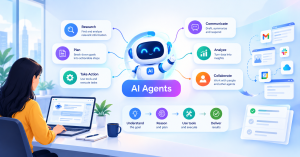
Agentic AI Developers build AI agents that can perform multi-step tasks, use tools and make decisions with limited human intervention.
Key skills
- LLM APIs
- Python
- Agent frameworks
- APIs and tool calling
- Workflow automation
Good fit for
- Software engineers moving into AI application development
- Developers interested in building AI agents
- Engineers with API and backend development experience
Why watch this role: Quess reported 260% YoY growth in hiring for Agentic AI Developers.
2. AI Software Engineer
AI Software Engineers combine traditional software engineering with modern AI capabilities.
Instead of building conventional applications alone, they may integrate:
- LLMs
- AI agents
- RAG systems
- AI APIs
- Automation workflows
The role is becoming increasingly important as companies embed AI directly into their software products and internal systems.
Why watch this role: Quess reported 225% YoY growth in hiring for AI Software Engineering roles focused on agentic AI and MCP systems.
3. GenAI / Agentic AI Engineer
GenAI and Agentic AI Engineers build applications around generative AI models and agent-based systems.
Their work can include:
- Enterprise copilots
- AI assistants
- Document intelligence
- RAG systems
- AI agents
- Automated workflows
These professionals need to understand both AI models and application development.
Why watch this role: Hiring for GenAI and Agentic AI Engineers grew 205% YoY in the Quess analysis.
4. AI Architect
As AI systems become more complex, organisations need professionals who can design the architecture connecting different technologies.
An AI Architect may need to understand:
Models + Data + APIs + Cloud + Security + Applications
Typical responsibilities include:
- Designing scalable AI architectures
- Selecting appropriate AI models
- Connecting AI with enterprise systems
- Planning cloud infrastructure
- Addressing security and governance
- Ensuring AI applications can scale
This role can be particularly relevant for experienced software engineers, technical leads and solution architects.
5. RAG and Agentic AI Lead
Enterprise AI applications rarely rely only on a model’s general knowledge.
Organisations increasingly want AI systems connected to their own:
- Documents
- Databases
- Policies
- Customer information
- Enterprise applications
Retrieval-Augmented Generation (RAG) is one approach used to connect AI models with trusted organisational information.
Professionals who can combine RAG with agentic workflows can therefore occupy a specialised position within enterprise AI teams.
Useful skills include:
- RAG architecture
- Vector databases
- Embeddings
- LLMs
- Agent frameworks
- Enterprise data integration
6. GenAI Solution Architect
A GenAI Solution Architect sits at the intersection of technology and business requirements.
Their job is not simply to select an AI model. They need to determine how AI can solve a specific business problem.
Key questions include:
- What problem are we solving?
- Which AI approach should we use?
- How will it integrate with existing systems?
- How should the solution be deployed?
- How do we maintain security and reliability?
The role therefore requires a combination of technical expertise, business understanding and AI knowledge.
Why watch this role: Quess reported 145% YoY growth in GenAI Solution Architect hiring.
7. AI Product Manager
AI is not only an engineering challenge. Product teams also need professionals who understand how AI should be incorporated into products.
AI Product Managers may need to determine:
- What should the AI-powered product do?
- Where should AI be used?
- What should remain human-controlled?
- How should product success be measured?
- How should incorrect AI outputs be handled?
- How should users interact with AI features?
The role combines:
Product thinking + AI literacy + User understanding + Business judgment
Why watch this role: Quess reported 120% YoY growth for AI Product Owner/Product Manager roles.
8. AI Platform Engineer
Building one AI application is very different from building infrastructure that allows hundreds of teams to build and deploy AI applications.
AI Platform Engineers help create the systems and platforms that support enterprise-scale AI development.
Their work may include:
- Model infrastructure
- APIs
- Deployment systems
- Monitoring
- Security
- Data pipelines
- Developer platforms
The goal is to make AI development scalable, reliable and easier for engineering teams.
Why watch this role: Quess reported 105% YoY growth for AI Platform Engineer and AI Systems Engineer roles.
9. GenAI Quality Engineer
One of the biggest challenges with AI is determining whether a system is actually working correctly.
Traditional software testing alone may not be enough because AI systems can produce different responses to similar inputs.
GenAI Quality Engineers increasingly work on:
- AI evaluation
- Hallucination detection
- Safety testing
- Reliability
- Test datasets
- Model behaviour
- Output quality
This makes AI quality a growing area as organisations move AI applications into production.
Why watch this role: Quess reported 82% YoY growth in Senior Lead Quality Engineer roles focused on GenAI.
10. AI Automation / DevSecOps Engineer
AI systems still need to be deployed, monitored, maintained and secured.
This creates opportunities for professionals who understand the intersection of:
AI + Infrastructure
and:
AI + Security
Key areas include:
- AI deployment
- Infrastructure automation
- CI/CD
- Monitoring
- Security
- Cloud platforms
- AI governance
Why watch this role: Quess reported 68% YoY growth for AI Automation / DevSecOps Platform Engineer roles.
What Skills Do These AI Jobs Have in Common?
The interesting part isn’t necessarily the job titles.
It’s the skills underneath them.
Across many of these roles, employers are increasingly looking for combinations of:
- Python
- LLM APIs
- RAG
- Vector databases
- Cloud
- APIs
- Agent frameworks
- Workflow automation
- AI evaluation
- Security
- Enterprise integration
The market is therefore moving beyond:
“Can you build a model?”
Toward:
“Can you make AI work in production?”
That shift is important for anyone planning an AI career in 2026.
What About Non-Technical Professionals?
AI careers aren’t limited to engineers.
Many opportunities are emerging at the intersection of AI and existing professional expertise.
For example:
- AI Product Managers can combine product expertise with AI literacy.
- AI Business Analysts can apply domain knowledge to AI initiatives.
- AI Transformation Professionals can help organisations redesign workflows around AI.
- Finance professionals can use AI for analysis and automation.
- HR professionals can apply AI to talent and workforce processes.
- Marketing professionals can use AI for content, research and customer insights.
- Operations professionals can use AI agents and workflow automation.
The strongest career move may therefore not be starting from zero.
It may be combining what you already know with AI.
What This Means for Your Career
Start with your existing skill set and identify where AI can extend it.
If you’re a developer
Focus on:
- LLMs
- AI agents
- RAG
- AI application development
- AI APIs
If you’re a data professional
Focus on:
- RAG
- Data pipelines
- Vector databases
- AI evaluation
- LLM applications
If you’re a product manager
Focus on:
- AI product design
- AI user experiences
- Model evaluation
- AI safety and reliability
If you’re in operations
Focus on:
- Workflow automation
- AI agents
- Process optimisation
- AI-enabled operations
If you’re a fresher
Focus on building projects that demonstrate what you can actually create.
Instead of simply listing AI courses on your resume, demonstrate your ability through:
- AI projects
- GitHub repositories
- Working prototypes
- Case studies
- AI applications
- Automation workflows
The important thing is to show evidence of capability.
The Talent500 Takeaway
India’s AI job market is expanding beyond traditional roles such as Data Scientist and Machine Learning Engineer.
The biggest opportunities may not simply be jobs with “AI” in the title.
They are roles where AI meets:
Engineering + Data + Product + Business + Domain Expertise
The career advantage will increasingly come from knowing how to apply AI to real-world problems, not just understanding AI concepts.
Ready to explore what’s hiring?
Search AI, technology, product and GCC opportunities on Talent500.
Read more such articles from our Newsletter here.