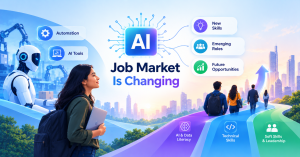
The biggest impact of artificial intelligence on employment may not come from creating entirely new AI-focused careers. Instead, it may come from transforming the jobs that already exist.
For example:
- A software engineer may spend less time writing repetitive code.
- A recruiter may spend less time searching and screening profiles.
- A financial analyst may automate parts of reporting and data analysis.
- A customer-support professional may handle fewer repetitive queries.
- A marketing professional may automate research and content production.
The job title may remain the same. But the work inside that job is changing. This distinction is becoming increasingly important as companies across India adopt AI.
AI Exposure Doesn’t Automatically Mean Job Loss
Research on India’s labour market suggests that generative AI will affect different occupations and tasks in very different ways.
One 2026 analysis using Indian employment data and ILO exposure categories found:
- 20.2% of workers are in roles considered augmentable by GenAI.
- Around 2.9% of workers are in roles with high automation potential.
The difference between augmentation and automation matters.
Augmentation
AI helps a professional perform their existing work faster or more effectively.
Automation
AI can potentially perform a task with limited or no human involvement.
Most jobs are likely to contain a combination of both.
For example, a financial analyst could use AI to:
- Generate an initial report.
- Summarize a dataset.
- Identify potential trends.
- Create a first draft of a presentation.
But the analyst may still need to:
- Verify the numbers.
- Interpret the findings.
- Identify risks.
- Make recommendations.
- Explain the results to stakeholders.
AI changes the workflow without necessarily eliminating the role.
Routine Work Is Increasingly Exposed
Research focused on India’s Global Capability Centres (GCCs) also highlights increasing pressure on routine work.
A Dell and Zinnov analysis cited by Business Standard estimated that:
- Around 55% of routine GCC work is already exposed to AI-driven automation.
- Approximately 60% of the workforce could require reskilling by 2030.
Separately, Quess analysis has reported declining demand for some routine non-technology GCC functions, including:
- Procurement.
- Transactional finance.
- Customer support.
- Generic analytics.
However, this doesn’t necessarily mean these functions will disappear. Instead, the routine parts of these roles are increasingly being automated or redesigned. The bigger question is what professionals will do with the time and capacity that AI creates.
The Job Is Becoming a Bundle of Tasks
Consider a financial analyst. Their work may traditionally include:
- Collecting data.
- Cleaning datasets.
- Creating spreadsheets.
- Preparing reports.
- Identifying trends.
- Explaining business implications.
AI can increasingly support some of the earlier, repetitive tasks. This allows the analyst to spend more time on:
Interpretation + decision support + communication + judgment
The same transformation can happen across many professions.
1. Recruiters
From:
- Searching for candidates.
- Screening profiles.
- Scheduling repetitive communication.
Toward:
- Hiring strategy.
- Candidate assessment.
- Stakeholder management.
- Employer branding.
2. Software Engineers
From:
- Routine coding.
- Boilerplate implementation.
- Basic debugging.
Toward:
- Architecture.
- System design.
- Product understanding.
- Technical decision-making.
3. Marketers
From:
- Content production.
- Basic research.
- Repetitive campaign tasks.
Toward:
- Strategy.
- Positioning.
- Experimentation.
- Customer insights.
Customer Support Professionals
From:
- Answering repetitive questions.
- Handling basic requests.
- Searching knowledge bases.
Toward:
- Complex problem resolution.
- Customer relationships.
- Escalation management.
- Customer experience improvement.
The role doesn’t necessarily disappear. Its centre of gravity changes.
India Is Already Seeing a New Type of AI-Enabled Worker
Microsoft’s 2026 Work Trend Index provides another indication of how quickly this transformation is happening.
The study found:
- 32% of India’s AI users were classified as “Frontier Professionals.”
- This compares with 16% globally across the ten markets studied.
- These professionals use AI agents for multi-step workflows.
- They actively redesign how work gets done.
Microsoft also reported that:
- 78% of India’s AI users said AI was enabling work that wasn’t possible a year earlier.
This points to an important possibility:
AI isn’t only reducing work. It can also create new types of work.
For example:
- A professional who previously spent hours preparing reports could build an AI-powered reporting workflow.
- A recruiter could create an automated candidate-sourcing system.
- A product manager could prototype an AI feature before involving an engineering team.
- A finance professional could develop an AI-assisted analysis workflow.
The technology changes what professionals contribute, not simply how quickly they complete existing tasks.
The Skills That Become More Valuable
As AI takes on more execution, certain human capabilities become increasingly important.
1. Judgment
Can you recognize when an AI-generated answer is:
- Incorrect?
- Incomplete?
- Misleading?
- Missing important context?
2. Domain Expertise
Do you understand the business or industry deeply enough to determine:
- What matters?
- What doesn’t?
- Which recommendation makes sense?
3. Communication
Can you:
- Explain AI-generated insights?
- Communicate complex ideas clearly?
- Work with different stakeholders?
- Translate technical information into business language?
4. Problem-Solving
Can you identify:
- The right problem to solve?
- The root cause?
- The best approach?
- The business impact?
5. Creativity
Can you discover new ways to use technology to:
- Improve processes.
- Build products.
- Solve customer problems.
- Create new business opportunities?
6. Ownership
Can you take responsibility for the final outcome rather than simply accepting whatever an AI system produces?
These capabilities don’t replace technical expertise.
They make technical expertise more valuable when combined with AI.
AI Literacy Is Becoming a Career Skill
You don’t need to become an AI engineer to become AI-literate.
At a minimum, professionals should understand:
- What AI is good at.
- Where AI tends to struggle.
- How to provide useful context.
- How to write effective instructions.
- How to verify AI-generated outputs.
- How to automate repetitive workflows.
- When human judgment is required.
This baseline knowledge can benefit professionals across almost every white-collar function.
What This Means for Freshers
The changing job market may create a particular challenge for entry-level professionals.
If AI takes over some of the routine tasks that previously helped junior employees learn through experience, companies may increasingly expect new hires to arrive with stronger practical skills.
That makes projects and hands-on experience more important.
Instead of simply saying:
“I completed a course in generative AI.”
A stronger profile could demonstrate:
“I built an AI application that solves a specific business problem.”
Or:
“I automated a workflow using an LLM and API.”
Or:
“I analyzed a real-world dataset and developed an AI-powered application around it.”
The goal is to demonstrate:
- What you can build.
- What you can automate.
- What problems you can solve.
- How you can apply AI to real-world situations.
Show what you can do, not just what you have studied.
What This Means for Experienced Professionals
Experienced professionals have a different opportunity. You already understand a business process, industry, or function. Now the opportunity is to understand how AI can transform it. Start by dividing your current responsibilities into three categories:
1. Automate
Ask:
- What could AI potentially perform without my direct involvement?
- Which tasks are repetitive?
- Which processes follow predictable steps?
2. Augment
Ask:
- Where could AI make me significantly faster?
- Which tasks could benefit from AI-generated drafts or analysis?
- Where could automation improve productivity?
3. Human Advantage
Ask:
- Where is human judgment essential?
- Where do relationships matter?
- Where is creativity required?
- Where does accountability remain important?
This exercise can help identify where AI can improve your current role and where you should focus your learning.
The Future Isn’t “AI vs. Humans”
A more useful way to think about the future of work may be:
Humans + AI vs. Humans Without AI
The WorldSkills leadership has similarly emphasized the need for workers to continuously update their skills as AI changes workplace requirements.
This means professionals may need to:
- Learn new AI tools.
- Refresh technical knowledge.
- Adapt workflows.
- Develop new domain skills.
- Continuously experiment with emerging technologies.
Continuous learning itself is becoming a career capability.
The Talent500 Takeaway
AI is unlikely to affect every profession in exactly the same way.
Some tasks will be:
- Automated.
- Augmented.
- Redesigned.
- Made more valuable through human expertise.
The professionals best positioned for this transition won’t necessarily be those who know the most about AI.
They may be the professionals who understand the intersection of:
AI + Domain Expertise + Business Problems
That combination is becoming one of the most valuable career capabilities to build today.
Build Your Next Career Move with Talent500
AI is changing how work gets done across:
- Technology.
- Finance.
- Marketing.
- Operations.
- Customer support.
- Product management.
- Business functions.
Whether you’re looking for an AI-focused role or want to build an AI-enabled career within your existing profession, combining domain expertise with AI skills can help you stay prepared for the changing job market.
Explore AI-enabled roles, GCC opportunities, and careers with leading global companies on Talent500.
Read more such articles from our Newsletter here.