Key Summary
AWS DevOps certification refers to the AWS Certified DevOps Engineer Professional credential. The current exam code is DOP-C02. It tests how engineers automate delivery, operations, and security on AWS. The exam has 75 questions and runs for 180 minutes. It costs $300. A scaled score of 750 out of 1,000 passes. AWS recommends two or more years of hands-on AWS work first.
Keeping the credential got easier in 2026. AWS opened a Skill Builder renewal path on June 23, 2026. Courses and hands-on labs now replace a full retake. Candidates pass faster when they build real pipelines before they read theory.
Who Is An AWS DevOps Engineer Professional?
An AWS DevOps Engineer Professional holds AWS’s senior DevOps credential. The title marks a validated skill level. It is not a job title on its own. These engineers own the path from commit to production. They build CodePipeline workflows and write CloudFormation or CDK stacks. They attach CloudWatch alarms that roll back bad releases. They manage access across many accounts with AWS Organizations and IAM Identity Center.
The role sits between developers and platform teams. Developers push the code. The DevOps engineer makes sure it ships safely and scales under load. Failed releases recover without manual steps. Job titles vary across companies. Common ones include DevOps engineer, platform engineer, cloud engineer, and site reliability engineer. The certification signals the same core skill set behind each title.
What’s The Best Way To Learn DevOps: Course, Self-Study Or Certification?
The best way uses all three, in that order. A course gives structure. Self-study builds real skill. The certification proves both. Courses suit learners who need a fixed schedule and a syllabus. Pick one updated for DOP-C02 and the current AWS service list. Older material still teaches OpsWorks and CodeStar. AWS retired both of those services. A good course spends most of its time in hands-on labs. Each module should end with a working pipeline or stack. Self-study works best for engineers already on AWS at work.
Build in a personal account and break things on purpose. Read the AWS documentation for every service the exam names. AWS Skill Builder adds guided labs in real AWS consoles. Talent500’s AI roadmap for DevOps and cloud engineers lists skills to add next. Certification works as a checkpoint at the end. Book the exam once a pipeline can be built without a tutorial open. Studying for the exam then fills the gaps that daily work never touched.
What Prerequisites Do I Need Before Starting AWS DevOps Certification?
AWS sets no formal prerequisites for this exam. No associate certification is required first. Anyone with an AWS Certification Account can register. AWS does recommend experience. The DOP-C02 exam guide asks for two or more years on AWS. That means provisioning, operating, and managing AWS environments. It also expects SDLC experience and programming or scripting skills.
Four skills matter most before study begins. Write Python or Bash scripts without help. Read and edit YAML and JSON templates with ease. Know IAM policies, VPCs, EC2, Lambda, and S3 well. Use Git branches and pull requests daily. Container basics help too, since ECS and EKS appear in deployment questions. Set up a practice account before week one. Turn on MFA for the root user. Sign in through IAM Identity Center. Add a budget alert to catch surprise charges from lab resources. Delete lab stacks at the end of each session. Plan extra lab weeks if most of that list is new.
What Does The AWS DevOps Certification Cover?
The DOP-C02 exam covers six weighted domains. The weights show where study hours pay off most.
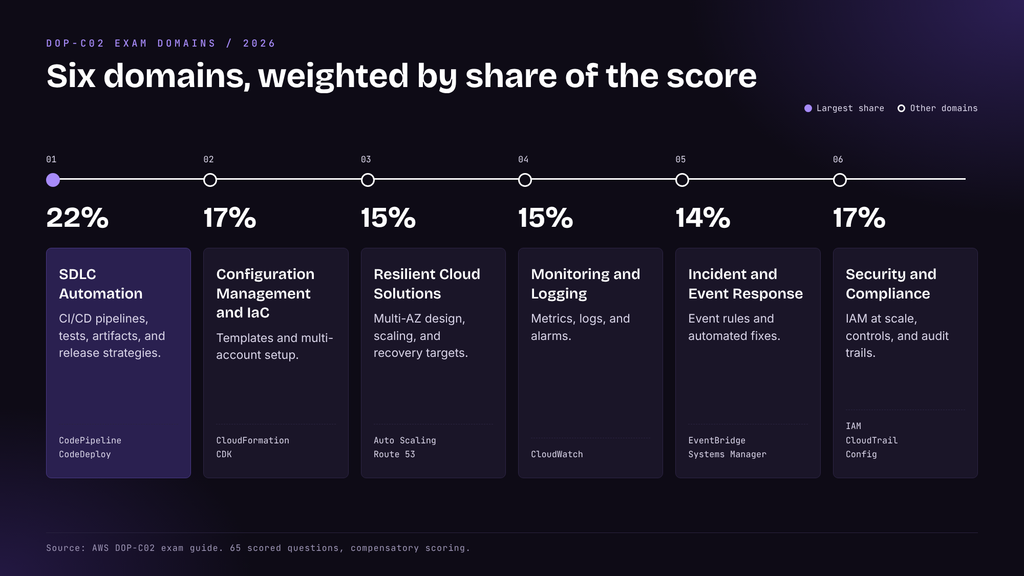
SDLC Automation carries 22%, the largest share. It tests CI/CD pipelines, automated testing, artifact storage, and deployment strategies. Expect canary, blue/green, and rolling releases on EC2, ECS, and Lambda. A typical question asks how to promote one artifact across three accounts. Configuration Management and IaC carries 17%. It covers CloudFormation, CDK, and multi-account setup with Organizations and Control Tower. Security and Compliance also carries 17%. It tests IAM at scale and automated security controls. Audit trails come from CloudTrail and AWS Config.
Resilient Cloud Solutions takes 15%. Questions cover multi-AZ design, scaling, and disaster recovery targets. Monitoring and Logging also takes 15%. It centers on CloudWatch metrics, logs, and alarms. Incident and Event Response carries 14%. It tests EventBridge rules, automated remediation, and troubleshooting of failed deployments. A typical scenario has a release failing overnight with no engineer online. The exam has 65 scored questions and 10 unscored ones. Questions come in two forms. Multiple choice has one right answer. Multiple response has two or more. Scoring is compensatory, so a strong domain can offset a weak one.
Which AWS Certification Is Best For DevOps?
The DevOps Engineer Professional is the best AWS credential for DevOps roles. It is the AWS exam built around delivery pipelines from end to end. Most engineers reach it through one associate exam.
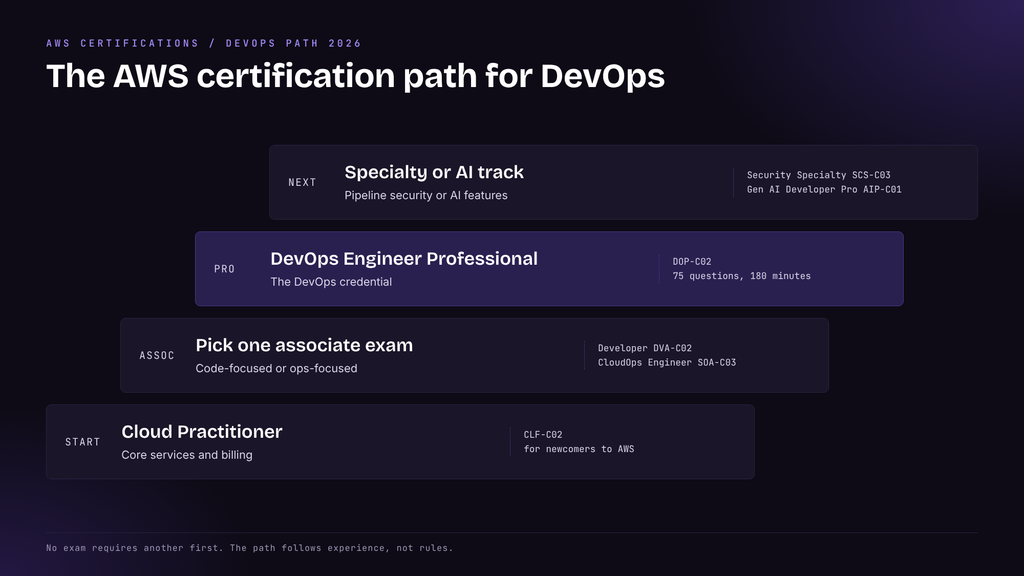
Cloud Practitioner (CLF-C02) is the entry point for newcomers. It covers core services, billing, and shared responsibility. Developer Associate (DVA-C02) suits engineers who write application code. It covers Lambda, APIs, and build basics.
CloudOps Engineer Associate (SOA-C03) suits operations-focused engineers. AWS renamed it from SysOps Administrator in 2025. The last SOA-C02 sitting was September 29, 2025. Security Specialty (SCS-C03) fits engineers who own pipeline security after the professional exam. Engineers who ship AI features can add the Generative AI Developer Professional. Its beta ended on March 31, 2026.
Is AWS DevOps Certification Worth The Money And Time At My Career Stage?
The value depends on where an engineer sits today. The cost stays fixed at $300 per attempt. Plan for two to three months of study.
Employers still put weight on the credential. Pearson released its 2026 Value of IT Certification Employer Report in April 2026. It surveyed 505 IT and HR leaders. 92% require or strongly prioritize certification. They estimate $17,646 in extra yearly value per certified IT employee. Freshers gain the least from this exam. Scenario questions assume production experience. Cloud Practitioner or an associate exam is the right first step. Six to twelve months of real project work should come next.
Engineers with two to five years of experience gain the most. The credential proves AWS depth during a move into DevOps or platform roles. Senior engineers use it to confirm breadth. It covers services they may not touch every day. Talent500’s DevOps engineer career path guide maps that breadth to each stage.
Build Me A Study Plan For AWS DevOps Certification That Fits Around A Full-Time Job
A 12-week plan fits most working engineers. It needs about eight hours a week. That means four weeknight hours and four on the weekend. The plan adds up to about 96 hours.
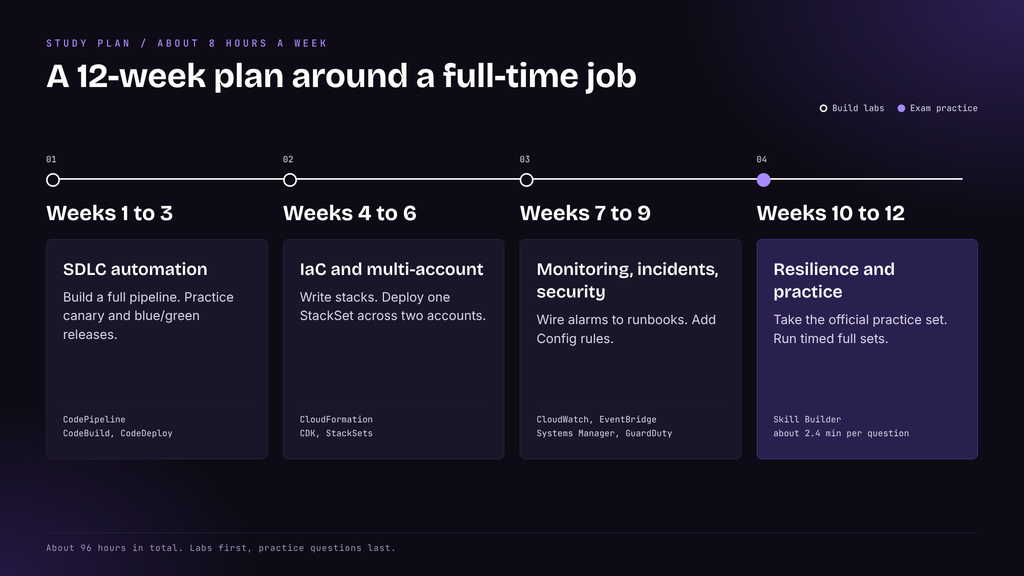
- Weeks 1 to 3 cover SDLC automation. Build a CodePipeline with CodeBuild tests and a CodeDeploy stage. Practice canary and blue/green releases.
- Weeks 4 to 6 cover IaC and multi-account setup. Write CloudFormation and CDK stacks. Deploy one StackSet across two accounts.
- Weeks 7 to 9 cover monitoring, incidents, and security. Wire CloudWatch alarms to EventBridge and Systems Manager runbooks. Add Config rules and review GuardDuty findings.
- Weeks 10 to 12 cover resilience and exam practice. Take the free Official Practice Question Set on AWS Skill Builder. Check every wrong answer against AWS documentation.
Time matters on exam day. 180 minutes for 75 questions leaves about 2.4 minutes each. Practice full timed sets in the final two weeks. Flag long scenarios and return to them at the end.A weekend lab covers the heaviest domain. This SAM template deploys a Lambda function with a canary release. A CloudWatch alarm rolls the release back on errors.
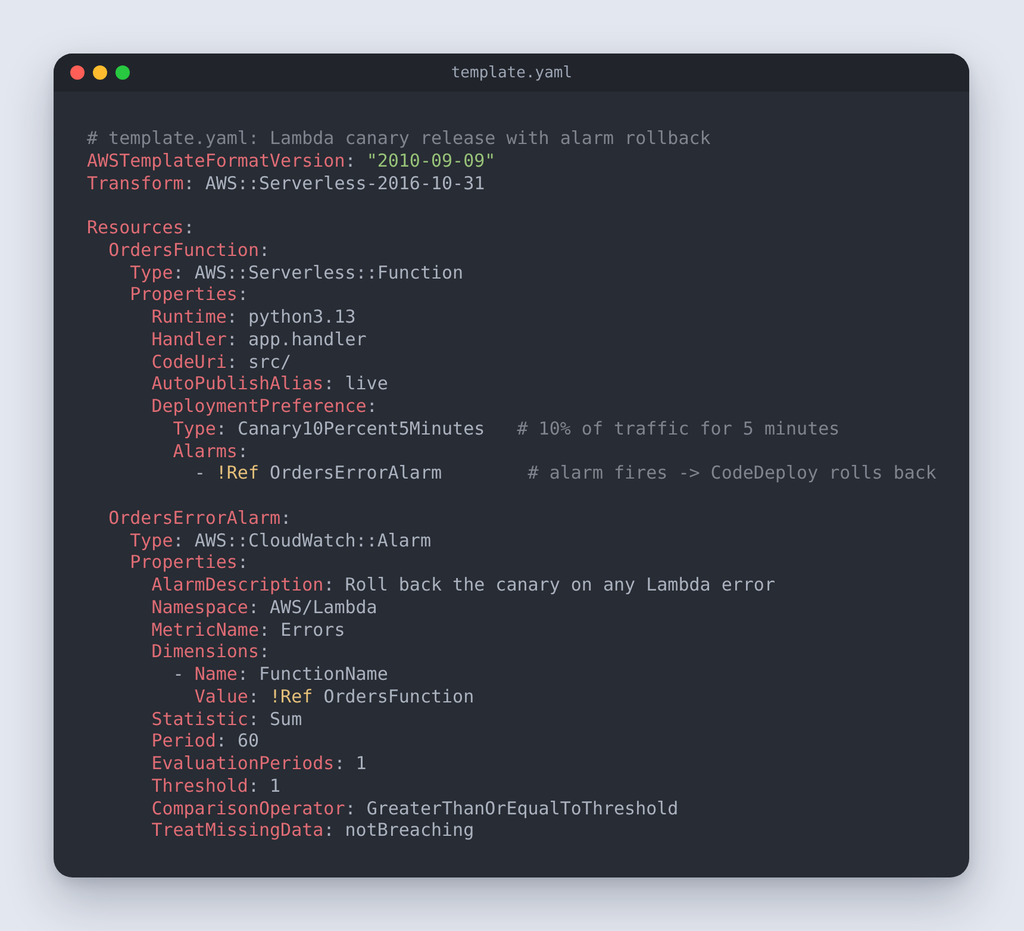
Deploy it from a terminal. Then change the code and deploy again to watch the canary.
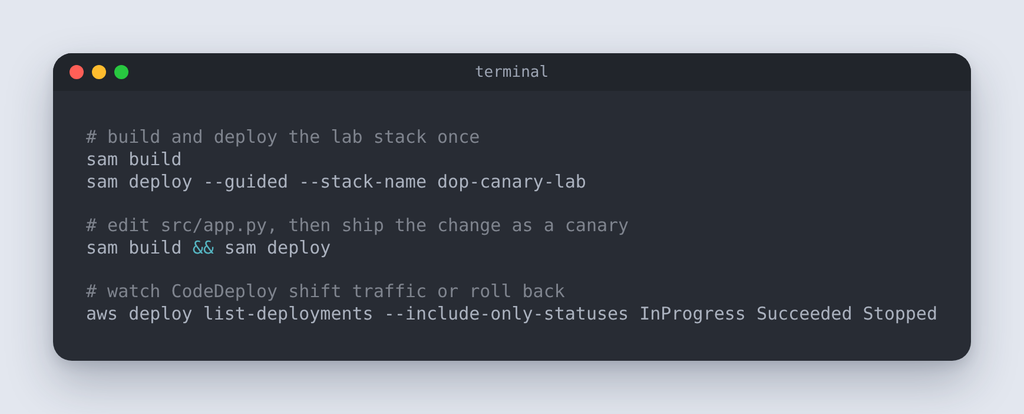
Pick your own stack name and Region during the guided deploy.
How To Earn An AWS DevOps Certification?
Earning the certification takes five steps, from account setup to renewal. First, create an AWS Certification Account. Non-native English speakers can request ESL +30 minutes there. The extra time then applies to every future exam. Second, book through Pearson VUE at a test center or online. A slot two to three weeks out locks in a study deadline. The exam runs in English, Japanese, Korean, and Simplified Chinese. AWS retires the Korean version after December 31, 2026. Third, sit the exam with valid government-issued ID. Online sessions need a private room and a working webcam. Localized exams include a toggle to view questions in English.
Fourth, check the certification account for results. They arrive within five business days. A failed attempt needs a 14-day wait before a retake. Fifth, keep the credential current. It stays valid for three years. AWS added a Skill Builder recertification path in June 2026. It opens 90 days before expiry and adds one year. Professional levels need 700 points, including two hands-on activities. An active Skill Builder subscription is required.
Who Should Go For AWS DevOps Certification?
The certification suits engineers who already run workloads on AWS. Five profiles gain the most. System administrators moving into automation fit first. The exam turns manual runbooks into Systems Manager and CloudFormation skills. Developers who own their own deployments fit next. Pipeline design and release strategies become formal, tested skills. Solutions architects gain operational depth. They learn how their designs behave during incidents and rollbacks.
Release and build engineers fit too. CodeBuild, CodeArtifact, and pipeline stages match their daily work. Site reliability and platform engineers round out the list. The exam validates monitoring, recovery, and multi-account work they already do. Engineers new to AWS should start lower on the certification path instead.
What Are The Benefits Of DevOps Certification?
The benefits fall into three groups: hiring, skills, and cost. Hiring teams get a fast, trusted signal. A verified credential shows AWS depth before the technical round. In Pearson’s 2026 report, 93% of employers saw positive ROI. That return came from certified IT staff.
Skills get tested under pressure. Scenario questions force trade-offs between cost, speed, and risk. The lab work leaves a portfolio of working pipelines to show in interviews. Multi-account and security questions push study beyond a single project. The next credential costs less. Passing any AWS exam earns a 50% discount on the next one. Many engineers use it for Security Specialty.
Conclusion
Start with an honest skills check against the six exam domains. Mark each domain as strong, partial, or new. Start study with the weakest high-weight domain. Fill the gaps with hands-on labs before any video course. Build at least one pipeline with a canary release and an alarm rollback. Book the exam once the Official Practice Question Set feels routine. Then plan the next credential with the 50% voucher.
Frequently Asked Questions (FAQs)
These answers cover the questions learners raise most about AWS DevOps certification.
What Is An AWS DevOps Certification?
It is the AWS Certified DevOps Engineer Professional credential. The DOP-C02 exam validates CI/CD and infrastructure as code on AWS. It also covers monitoring and security automation.
Which AWS DevOps Certification Is Best For Beginners?
Beginners should start with Cloud Practitioner or Developer Associate. The DevOps Engineer Professional assumes about two years of hands-on AWS work.
What Are The Prerequisites For An AWS DevOps Certification?
There are no formal prerequisites. AWS recommends two or more years managing AWS environments. Scripting skills and SDLC experience also help.
What Topics Are Covered In The AWS DevOps Certification Exam?
The exam covers six domains. They are SDLC automation, IaC, resilience, monitoring, incident response, and security. SDLC automation carries the most weight at 22%.
How Can You Prepare For An AWS DevOps Certification?
Build real pipelines in a personal AWS account first. Then work through the free Official Practice Question Set on AWS Skill Builder.