Frontend development focuses on the visual elements of a website or application that users interact with, while backend development manages the server, database, business logic, and data processing behind the scenes. The primary differences between frontend and backend development involve the technologies, skills, responsibilities, and problems developers solve. Both are essential for building functional, reliable, and user-friendly digital products.
Beginners should choose a learning path based on their interests and career goals. Frontend is a natural starting point for people interested in visual design and user interaction, while backend suits those who enjoy logic, data, APIs, and system architecture. Learning both can lead to full-stack development.
What Is Front-End Development?
Front-end development is the process of building the parts of a website or web application that users see and interact with. It includes page layouts, navigation menus, buttons, forms, animations, images, and other interface elements.
For example, when you open an e-commerce website, the product images, search bar, filters, shopping cart icon, and checkout form are part of the frontend. A front-end developer makes these elements functional, accessible, responsive, and easy to use.
Front-end development connects design with implementation. Designers may create layouts and prototypes, but front-end developers translate those designs into working interfaces using web technologies.
How Does Front-End Development Work?
A browser processes frontend code to display a website. Three core technologies form the foundation of this process:
- HTML: Defines the structure and content of a webpage.
- CSS: Controls the appearance, layout, spacing, colours, and responsiveness.
- JavaScript: Adds interactivity and dynamic behaviour.
Consider a simple button on a webpage. HTML creates the button, CSS styles it, and JavaScript determines what happens when someone clicks it.
<button id=”welcomeButton”>Click Me</button>
<script>
document
.getElementById(“welcomeButton”)
.addEventListener(“click”, () => {
alert(“Welcome to the website!”);
});
</script>
In this example, the browser displays a button and shows a message when a user clicks it. This is a basic example of frontend interactivity.
Modern frontend development involves more than writing HTML, CSS, and JavaScript. Developers use component-based frameworks, manage application state, connect interfaces to APIs, and optimize performance across different devices and browsers.
What Does the Frontend Handle in a Real Website?
The frontend is responsible for the user-facing experience, including:
- Displaying content, images, and interactive elements.
- Creating responsive layouts for desktops, tablets, and mobile devices.
- Validating form inputs before submission.
- Showing loading indicators, error messages, and success notifications.
- Sending requests to backend services and displaying the returned data.
- Improving accessibility, usability, and browser compatibility.
For example, when a user searches for a product, the frontend collects the search term, sends it to the relevant backend endpoint, and displays the matching products returned by the server.
The frontend can also perform basic validation, such as checking whether an email field is empty. However, important security checks must also happen on the backend because browser-side code can be modified or bypassed.
What Is Back-End Development?
Back-end development focuses on the server-side systems that make a website or application function. It includes business logic, database operations, authentication, authorisation, API development, and data processing.
Users generally do not interact directly with the backend. Instead, the frontend communicates with it through requests and receives responses that help the application perform its functions.
Consider an online shopping application. When a customer places an order, the backend validates the request, checks product availability, calculates the final amount, processes the order, and stores the relevant information. Depending on the application, it may also coordinate with payment services, inventory systems, and notification services.
How Does Back-End Development Work?
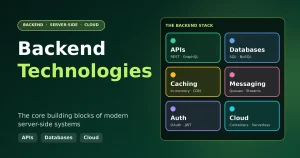
A typical backend consists of three major components:
- Server: Receives requests and runs the application logic.
- Application logic: Applies the rules that determine how requests should be processed.
- Database: Stores and retrieves information such as user profiles, products, and orders.
A backend can also include APIs, authentication services, background jobs, caching systems, and integrations with external applications. For example, a frontend might request a list of products from a backend API. The backend receives the request, queries the database, and returns the results in a format the frontend can process. Here is a simple example using Python and FastAPI:
from fastapi import FastAPI
app = FastAPI()
@app.get(“/products”)
def get_products():
return [
{“id”: 1, “name”: “Laptop”, “price”: 55000},
{“id”: 2, “name”: “Keyboard”, “price”: 1500}
]
This endpoint responds to a request sent to /products with a list of products in JSON format. A frontend application can use that response to display product cards or populate a shopping page. This example uses sample data rather than a database, but the same endpoint could be extended to retrieve products from a database.
What Does the Backend Handle in a Real Website?
Backend developers typically work on:
- Processing requests from web and mobile applications.
- Designing and maintaining APIs.
- Storing, retrieving, and updating database records.
- Implementing authentication and access control.
- Enforcing business rules and validating sensitive operations.
- Managing errors, logging, and monitoring.
- Improving performance, reliability, and scalability.
- Integrating payment gateways, email services, and third-party systems.
For example, a login form may appear on the frontend, but the backend is responsible for verifying the submitted credentials, checking account permissions, and establishing an authenticated session or issuing an appropriate token.
Backend development is especially important when an application handles sensitive information, financial transactions, large amounts of data, or complex business operations.
Front-End vs Back-End Development
The main difference between frontend and backend development is the part of an application each one is responsible for. Frontend developers build the user-facing interface, while backend developers build the systems that process requests, manage data, and enforce application rules. The differences become clearer when you compare their responsibilities, technologies, and typical tasks.
1. Primary Focus
- Front-end development focuses on the user interface and experience. Developers create the elements users see, such as navigation menus, product cards, forms, dashboards, and interactive controls.
- Back-end development focuses on server-side operations. Developers implement business logic, manage data, process requests, and ensure that application features work correctly behind the scenes.
2. Where the Code Runs
Frontend code primarily runs in the user’s browser, where it controls how the interface is displayed and how it responds to user interactions. Backend code runs on servers or managed cloud environments. It processes incoming requests, interacts with databases, and returns responses to applications. Modern frameworks can blur this distinction because some frontend frameworks also support server-side rendering and server-side code. However, the distinction between user-facing and server-side responsibilities remains useful for beginners.
3. Technologies Used
Frontend developers typically work with HTML, CSS, JavaScript, and TypeScript. They may also use frameworks and libraries such as React, Angular, and Vue.js. Backend developers commonly use Python, Java, JavaScript, TypeScript, Go, or C#. Their tools may include frameworks such as Django, FastAPI, Express.js, Spring Boot, and ASP.NET Core. Both roles use Git, testing tools, and debugging techniques, but their day-to-day workflows often differ.
4. Data Handling
Frontend developers collect user input, display information, and send requests to backend services. They may format data for presentation and perform basic input checks. Backend developers validate requests, apply business rules, retrieve or update database records, and enforce security requirements. For example, a shopping cart interface may display the total price of selected products. The backend must still validate product prices, availability, discounts, and other rules before confirming an order.
5. Performance and Security
Front-end performance focuses on page loading, responsiveness, rendering, and smooth user interactions. Accessibility and browser compatibility are also important considerations. Backend performance involves response times, database queries, concurrent requests, resource utilization, and system reliability. Security is shared across both areas, but sensitive operations must be enforced on the backend. A frontend can hide an administrative button, for instance, but the backend must independently verify whether the user has permission to perform the requested action.
6. Typical Tasks
A front-end developer might build a responsive checkout form, implement product filters, integrate an API, and fix a layout problem on mobile devices. A backend developer might create the order API, validate the checkout request, check inventory, save order details, and handle errors during payment processing. Both developers contribute to the same feature, but they solve different parts of the problem.
What’s the Difference Between Frontend and Backend, Explained Simply?
Think of a restaurant. The dining area, menu, table layout, and ordering experience represent the frontend. They shape what customers see and how they interact with the restaurant. The kitchen, inventory management, order processing, and coordination between staff represent the backend. Customers may not see these operations, but they are necessary to deliver the experience.
A restaurant cannot serve customers effectively with an attractive dining area and a dysfunctional kitchen. Similarly, a website needs a usable frontend and a reliable backend to work well. The comparison is not absolute, but it offers a useful starting point for beginners.
What Are the Skills Required for Front-End Developers?
Front-end developers need a combination of programming knowledge, interface-building skills, problem-solving ability, and an understanding of how users interact with applications. Beginners do not need to master every framework before applying for entry-level roles. A strong foundation in web technologies and the ability to build working projects are more useful than learning several tools without understanding their purpose.
1. HTML and CSS
HTML provides the structure of a webpage, while CSS controls its presentation. Developers need to understand semantic HTML, forms, selectors, the box model, Flexbox, Grid, responsive design, and media queries. These concepts help them create layouts that work across screen sizes.
2. JavaScript
JavaScript enables interaction and dynamic behaviour. Developers should understand variables, functions, arrays, objects, events, promises, asynchronous programming, and the Document Object Model (DOM). For example, a front-end developer may use JavaScript to update a cart count when a user adds a product to their shopping cart.
3. A Frontend Framework or Library
React, Angular, and Vue.js help developers build complex interfaces using reusable components and structured approaches to managing application behaviour. React is a common starting point for beginners, but the best choice depends on the requirements of target employers and the projects being built.
4. API Integration
Front-end developers must understand how to send HTTP requests, interpret JSON responses, and handle loading states, errors, and unsuccessful requests. For example, a dashboard might call an API to retrieve sales data and then display that information in charts.
5. Responsive Design and Accessibility
Websites should work on different devices and remain usable by people with different abilities. Developers need to understand responsive layouts, keyboard navigation, semantic elements, colour contrast, and accessible form labels.
6. Git and Debugging
Git helps developers track code changes and collaborate with other developers. Browser developer tools help identify layout problems, inspect network requests, and debug JavaScript errors. These skills are useful in almost every professional frontend role.
What Are the Skills Required for Back-End Developers?
Backend developers need programming fundamentals, database knowledge, API development skills, and an understanding of security and server-side operations.
The depth required depends on the role. A junior backend developer may focus on implementing endpoints and database queries, while a senior developer may design distributed systems and make architectural decisions.
1. A Backend Programming Language
Beginners should choose one language and learn it well before switching between several.
Common choices include:
- Python: Often approachable for beginners and widely used in web development, automation, and data-related work.
- Java: Common in enterprise applications and large-scale backend systems.
- JavaScript or TypeScript: Useful for developers who want to use the same language across frontend and backend applications.
- C#: Frequently used with the .NET ecosystem.
- Go: Used in backend services and infrastructure-oriented applications.
The right language depends on the type of work you want to pursue and the technology stacks used by your target employers.
2. Databases and SQL
Backend developers need to understand how data is stored, queried, updated, and protected. Relational databases such as PostgreSQL and MySQL use SQL. Developers should learn tables, relationships, joins, indexes, transactions, and database constraints. They should also understand when a non-relational database, such as MongoDB, may be suitable.
3. APIs and HTTP
APIs allow applications to communicate with one another. Backend developers need to understand HTTP methods, status codes, request headers, response bodies, authentication, and API design. For example, a GET request may retrieve a product, while a POST request may create a new order.
4. Backend Frameworks
Frameworks such as Django, FastAPI, Spring Boot, Express.js, and ASP.NET Core provide tools for building server-side applications. Learning one framework alongside a programming language helps beginners understand routing, request validation, error handling, middleware, and application structure.
5. Security and Authentication
Backend developers must know how to protect application data and restrict access to sensitive operations. Important concepts include password hashing, session management, token-based authentication, authorisation, input validation, secure configuration, and protection against common web vulnerabilities.
6. Testing, Deployment, and Monitoring
Developers should learn to write unit and integration tests, use Git, understand basic command-line operations, and deploy applications to a suitable environment. Knowledge of Docker, cloud platforms, logging, and monitoring becomes increasingly useful as applications grow in complexity.
What Are the Programming Languages Used in Front-End vs Back-End?
The languages used in frontend and backend development overlap in some areas, but their typical purposes differ.
Frontend Programming Languages
HTML structures page content, CSS styles it, and JavaScript adds interactivity. TypeScript, which builds on JavaScript with static type checking, is widely used in modern frontend projects. For example, TypeScript can help developers catch certain mistakes while writing code for a large React application. Frontend development is therefore not limited to a single programming language. It combines markup, styling, and programming to create a complete user interface.
Backend Programming Languages
Backend development supports a broader range of programming languages because server-side systems have different requirements. Python is used with frameworks such as Django and FastAPI. Java is commonly paired with Spring Boot. JavaScript and TypeScript can run on the server using Node.js, while C# is often used with ASP.NET Core. Go is another option for services that benefit from its performance and concurrency features. The choice of language depends on the project, existing infrastructure, team expertise, performance requirements, and hiring needs.
Can You Use the Same Language for Frontend and Backend?
Yes. JavaScript and TypeScript can be used for both frontend and backend development.
For example, a developer could build a React frontend and an Express.js backend using JavaScript. This can simplify language learning and allow code or types to be shared in certain project structures.
However, using the same language does not eliminate the need to learn different concepts. Frontend developers still need to understand browsers, accessibility, and interface design. Backend developers still need to understand databases, server-side security, APIs, and data processing.
What Are the Frameworks and Tools for Front-End and Back-End?
Frameworks and tools help developers write, test, organise, and maintain applications more efficiently. Beginners should understand the purpose of each tool instead of treating a long list of technologies as a learning checklist.
Front-End Frameworks and Tools
- React: A JavaScript library for building user interfaces with reusable components.
- Angular: A comprehensive framework for building structured web applications, often used in enterprise environments.
- Vue.js: A progressive JavaScript framework that supports component-based interface development.
- Next.js: A React-based framework that supports server rendering, static generation, routing, and other application features.
- Vite: A development and build tool that supports fast feedback during frontend development.
- Tailwind CSS: A utility-first CSS framework for styling interfaces.
- Git and browser developer tools: Used to track changes, inspect page behaviour, debug issues, and examine network requests.
A beginner could start with HTML, CSS, and JavaScript, then move to React or another framework after becoming comfortable with the fundamentals.
Back-End Frameworks and Tools
- Django: A Python web framework that includes many built-in features for developing web applications.
- FastAPI: A Python framework for building APIs with support for type hints and automatic API documentation.
- Express.js: A lightweight Node.js framework for creating web servers and APIs.
- Spring Boot: A Java-based framework used to build standalone, production-ready applications.
- ASP.NET Core: A framework for building web applications and APIs with C# and .NET.
- PostgreSQL and MySQL: Relational databases used to store structured application data.
- MongoDB: A document-oriented database suitable for certain data models and application requirements.
- Docker: A tool for packaging applications and their dependencies into containers.
- Postman or similar API clients: Tools for sending requests and testing API responses.
Beginners should choose a small, compatible set of technologies. For example, Python, FastAPI, and PostgreSQL provide a practical starting stack for backend development.
What Are the Roles and Responsibilities of Front-End vs Back-End Developers?
Although frontend and backend developers work on different parts of an application, their responsibilities often overlap during planning, implementation, testing, and release.
Front-End Developer Responsibilities
Front-end developers translate designs into functional interfaces and make sure those interfaces behave correctly.
Their day-to-day responsibilities may include:
- Building webpages and reusable UI components.
- Implementing layouts and responsive behaviour.
- Integrating APIs and displaying returned data.
- Validating form inputs and presenting useful error messages.
- Improving accessibility and browser compatibility.
- Debugging visual and interaction issues.
- Testing interface behaviour across devices.
- Collaborating with designers, backend developers, and product teams.
For example, a front-end developer working on a banking application might build the account dashboard, transaction filters, transfer form, and confirmation screens.
The developer would also ensure that the interface handles unsuccessful requests and does not present a transaction as complete before receiving a reliable confirmation from the backend.
Back-End Developer Responsibilities
Back-end developers implement the systems that process application requests and manage data.
Their responsibilities may include:
- Developing APIs and server-side features.
- Designing database schemas and queries.
- Implementing business rules and data validation.
- Managing authentication and authorisation.
- Integrating third-party services.
- Writing automated tests.
- Investigating server errors and performance problems.
- Deploying, monitoring, and maintaining backend services.
For the same banking application, a backend developer might implement account balance retrieval, transaction history, transfer validation, and transaction recording.
The backend must verify permissions, validate the transaction, and preserve data integrity. These checks cannot be left to the frontend alone.
What Are the Career Opportunities in Front-End and Back-End Development?
Both fields offer entry-level opportunities and routes into more specialised engineering roles. The opportunities available to a beginner depend on technical fundamentals, portfolio quality, interview performance, and the requirements of individual employers.
Common Job Roles After Learning Front-End Development
- Junior Front-End Developer: Builds and maintains interface components under the guidance of experienced developers.
- Front-End Developer: Implements application features, integrates APIs, and improves interface performance and usability.
- UI Engineer: Focuses on translating designs into accurate, reusable, and accessible interfaces.
- React Developer: Builds applications using React and its supporting ecosystem.
- Web Developer: Works on websites and web applications, sometimes covering both frontend and basic backend tasks.
- With experience, developers may progress towards senior frontend engineering, frontend architecture, design systems, or technical leadership.
Common Job Roles After Learning Back-End Development
- Junior Back-End Developer: Implements APIs, database operations, and server-side features.
- Back-End Developer: Builds and maintains application services, business logic, and data integrations.
- API Developer: Focuses on designing and maintaining interfaces that allow systems to communicate.
- Software Engineer: Works across application components and may specialise in backend services.
- Cloud or Platform Engineer: With additional infrastructure and operational skills, a backend developer can move towards cloud systems, deployment platforms, and service reliability.
Experienced backend developers may progress into senior engineering, systems architecture, distributed systems, or engineering leadership.
Is the Front End or Backend Easier to Get a First Job in Right Now?
There is no universal answer for 2026. Hiring demand varies by region, industry, company size, and experience level. Neither frontend nor backend development guarantees an easier route into a first job.
Frontend can be approachable because beginners can build visible projects using a browser and relatively little infrastructure. However, entry-level candidates still need to demonstrate strong JavaScript fundamentals, responsive design, accessibility, debugging, and the ability to work with APIs. Backend development may suit candidates who enjoy programming logic, data modelling, and application behaviour. Entry-level roles often expect knowledge of a programming language, SQL, API development, testing, and basic security.
A practical way to compare opportunities is to review recent job descriptions in your target location. Look for recurring requirements, the technologies employers use, and whether roles accept fresh graduates or candidates with limited professional experience. Build two or three projects that demonstrate those skills. A working portfolio with clear documentation is more useful than a résumé listing technologies you have only studied briefly.
How Do Front-End and Back-End Work Together?
Frontend and backend development connect through APIs and shared application requirements. The frontend handles user interactions, while the backend processes requests and returns data or status information.
Consider a user signing in to an online learning platform.
- The user enters their credentials. The frontend displays a login form and collects the input.
- The frontend sends a request. It submits the credentials to a backend authentication endpoint over HTTPS.
- The backend validates the request. It checks the credentials using the application’s authentication process.
- The backend returns a response. The response indicates whether authentication succeeded and provides the appropriate session or authentication mechanism.
- The frontend updates the interface. On success, it may display the user’s dashboard. On failure, it shows an appropriate error message.
The frontend does not need to know how the backend stores user records or verifies passwords. It only needs to understand the API contract and how to handle the response. Similarly, the backend does not need to control every visual detail of the login form. It needs to receive the expected data, apply the correct rules, and return a predictable response. Clear API contracts, consistent error handling, and coordinated testing help both teams build features without unnecessary integration problems.
Which Is More Important, Front-End vs Back-End Development?
Neither frontend nor backend development is inherently more important. Their importance depends on the product, its users, and its technical requirements.
A content website may place considerable emphasis on accessibility, page speed, responsive design, and search visibility. A financial application may require especially strong backend security, transaction integrity, and auditability. Both still need a functioning interface and reliable server-side systems. A well-designed frontend cannot compensate for a backend that loses data or exposes sensitive information. Likewise, a technically sound backend cannot deliver a good user experience if the interface is confusing, inaccessible, or unreliable.
The two disciplines solve different problems within the same system. Product quality depends on how effectively they work together.
Career Options in Frontend Development and Backend Development
Choosing between frontend and backend development is easier when you consider the kind of work you would enjoy doing regularly, rather than focusing only on the tools or job titles.
Frontend Development Career Options
Frontend development may be a good fit if you enjoy:
- Turning designs and ideas into working interfaces.
- Seeing the immediate results of your code.
- Improving how users navigate and interact with applications.
- Working with layouts, visual details, and browser behaviour.
- Building interactive dashboards, websites, and web applications.
A possible learning path is HTML and CSS, followed by JavaScript, Git, API integration, and a frontend framework such as React. You can then build projects that demonstrate responsive design, accessibility, reusable components, and real data integration.
Backend Development Career Options
Backend development may be a good fit if you enjoy:
- Solving logic-heavy programming problems.
- Designing APIs and application workflows.
- Working with databases and structured information.
- Understanding how systems communicate.
- Improving reliability, security, and performance.
A possible learning path is to choose one programming language, learn data structures and basic algorithms, practise SQL, and build APIs with a backend framework. Next, add automated testing, authentication, deployment, and database integration.
Projects such as an expense tracker API, a task management service, or an inventory management system can help demonstrate these skills.
Which One Should I Choose? Frontend, Backend, or Full Stack?
Your choice should reflect your interests, learning goals, and the kind of work you want to pursue. You do not need to master both frontend and backend development before applying for your first role.
Choose Frontend if You Enjoy Building Interfaces
Start with HTML, CSS, and JavaScript. Learn responsive design, accessibility, and API integration before moving to a framework. Build projects such as a personal portfolio, a product catalogue, or a dashboard that retrieves information from an API. These projects help demonstrate that you can create interfaces that work beyond static mockups.
Choose Backend if You Enjoy Logic and Data
Start with one programming language, then learn SQL, HTTP, APIs, and a backend framework. Build a service that supports user accounts, data validation, and database operations. Add tests and document your API so another developer can understand and use it.
Choose Full Stack if You Want to Understand the Entire Application
Full-stack developers work across frontend and backend systems. They can build interfaces, implement APIs, and connect applications to databases. This breadth can be valuable in small teams and product-focused environments, but it also means learning more concepts. A practical approach is to establish a strong foundation in one area before expanding into the other. For example, you could learn React for the frontend and FastAPI with PostgreSQL for the backend. Build a complete application in which users can create, update, and retrieve records through a functional interface.
Which Should a Beginner Learn First in 2026?
Start with the area that best matches your interests and the roles you want to pursue. If you are unsure, try a small project in each area before committing to a longer learning plan. Build a simple webpage with an interactive form to experience frontend development. Then create a small API that accepts and returns data to experience backend development.
Compare the problems you found interesting, the concepts you enjoyed learning, and the type of work you would be comfortable doing consistently. Also review job requirements in your target market before deciding which technologies to prioritise.
Do You Need to Learn Both, or Is Specialising in One Enough?
Specialising in one area is enough to begin a career. Employers hire frontend and backend developers for focused responsibilities, and a strong foundation in one discipline can be more valuable than superficial knowledge of both.
However, learning the basics of the other area improves collaboration and helps you understand how an application works as a whole. A frontend developer benefits from understanding API design and database-backed workflows. A backend developer benefits from understanding browser behaviour, HTTP requests, and how users interact with interfaces. You can expand into full-stack development later if your interests and career opportunities support it.
Conclusion
Frontend and backend development are two complementary parts of modern web development. Frontend developers create the interfaces users interact with, while backend developers build the systems responsible for processing requests, managing data, and enforcing business rules. For beginners exploring frontend vs backend explained for beginners 2026, the best starting point is not necessarily the field with the most popular framework or the most promising job title.
It is the one that matches your interests and gives you a clear path towards building practical skills. Learn the fundamentals, choose a manageable technology stack, and build projects that solve real problems. Once you understand one side well, learning the other becomes easier. Whether you specialise in frontend, backend, or eventually full-stack development, consistent practice and demonstrable skills will help you prepare for the next stage of your career.
Frequently Asked Questions (FAQs)
1. What Is Frontend Development?
Frontend development involves building the parts of a website or application that users see and interact with. It uses technologies such as HTML, CSS, and JavaScript to create interfaces, implement interactions, and ensure that applications work across devices and browsers.
2. What Is Backend Development?
Backend development involves building the server-side systems that process requests, manage application logic, communicate with databases, and protect data. Backend developers commonly work with programming languages such as Python, Java, JavaScript, and C#, along with frameworks, databases, and APIs.
3. What Is the Main Difference Between Frontend and Backend?
The frontend manages the user-facing interface, while the backend handles server-side processing, data management, and business logic. The two communicate through APIs to deliver a complete application experience.
4. What Does a Front-End Developer Do Daily?
A front-end developer typically builds interface components, implements designs, integrates APIs, fixes UI bugs, improves responsiveness and accessibility, and tests application behaviour. They also collaborate with designers, backend developers, and other team members to deliver product features.
5. What Does a Backend Developer Do Daily?
A backend developer typically builds APIs, writes server-side logic, works with databases, implements security checks, writes automated tests, and investigates performance or reliability issues. Depending on the role, they may also help deploy applications and monitor production systems.