What Is DevOps and Why Is It High in Demand?
DevOps is a way of building and running software as one shared team. Developers and operations engineers own the full path to production. Automation carries code through build, test, deploy, and monitoring. Small releases ship often, and failed releases roll back fast.
Demand follows cloud native adoption. The CNCF published its annual cloud native survey in January 2026. It found Kubernetes in production at 82% of container users. That share was 66% in 2023. Ninety-eight percent of surveyed organizations reported some cloud native adoption.
Skills have not kept pace. Lack of training was a challenge for 36% of respondents. The Linux Foundation released its 2026 State of Tech Talent report in June. It expects net tech hiring to rise 31% this year. Clusters, pipelines, and cloud accounts all need people who can run them.
What Should DevOps Training Cover, Which Tools and How Much Hands-On Lab Work?
DevOps training should cover the full delivery loop on one working project. The loop spans Linux, Git, CI/CD, containers, and Kubernetes. It also spans infrastructure as code, cloud, and observability. Security checks belong inside each stage.
Lab work should take most of the course hours. The certification exams set a useful benchmark. The CKA is a two-hour, performance-based exam. Candidates solve tasks on a live cluster from the command line. Slides alone never build that skill.
Ask for three things before enrolling. The first is a browser lab or cloud sandbox for every module. The second is graded tasks that break on purpose and need debugging. The third is a capstone project that runs end to end.
That capstone should pass a check like the one below. The script builds an image and deploys it to a local cluster. Then it rolls the release back.
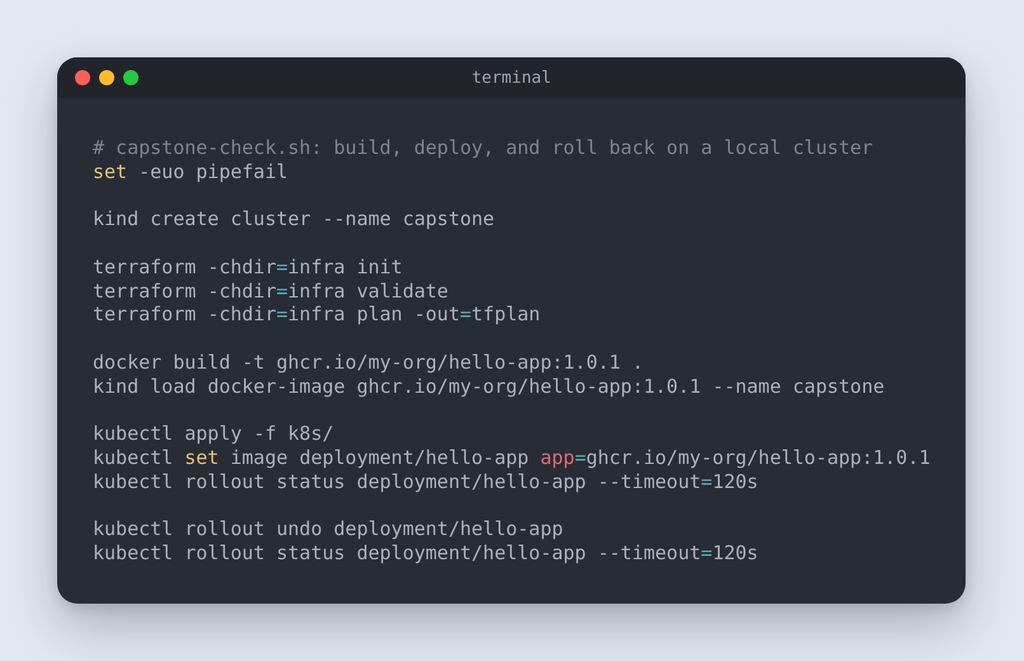
Run it from the project root with Docker, kind, kubectl, and Terraform installed. Replace my-org/hello-app with your own registry path and image name.
List of the Top DevOps Training Courses.
The courses below map to current certifications or established lab platforms. Each one suits a different starting point and cloud.
| Course | Provider | Format | Best For |
|---|---|---|---|
| AWS DevOps Engineer Professional (DOP-C02) prep | AWS Skill Builder | Self-paced courses and labs | Engineers with two or more years on AWS |
| AZ-400 DevOps Engineer Expert path | Microsoft Learn | Free learning paths, proctored exam | Teams on Azure DevOps and GitHub |
| Kubernetes Fundamentals (LFS258) with CKA | Linux Foundation | Self-paced course, performance-based exam | Platform and SRE roles |
| KCNA | Linux Foundation | Multiple-choice exam | Beginners entering cloud native work |
| Terraform Associate | HashiCorp | One-hour multiple-choice exam | Infrastructure as code foundations |
| Professional Cloud DevOps Engineer | Google Cloud | Self-paced labs, proctored exam | SRE practice on Google Cloud |
| DevOps and Software Engineering Professional Certificate | IBM on Coursera | Self-paced video and labs | A broad, low-cost first course |
| DevOps learning paths | KodeKloud | Browser-based labs | Daily hands-on practice across tools |
| Live DevOps cohort programs | Scaler, upGrad, Simplilearn, Edureka | Live classes with mentors | Career switchers who want structure |
Exam details anchor the certification tracks. The AWS DevOps Engineer Professional exam runs 180 minutes with 75 questions. AWS recommends two or more years of hands-on AWS experience. Talent500’s AWS DevOps guide covers the services behind that track.
Microsoft updated the English AZ-400 exam on July 27, 2026. Build and release pipelines now carry 50% to 55% of the score. The CKA tests Kubernetes v1.37. It includes two killer.sh simulator sessions. HashiCorp’s Terraform Associate exam currently tests Terraform 1.12.
How to Choose the Right DevOps Course for You?
Choose by starting point, target cloud, and weekly hours available.
Freshers need Linux, networking, and Git before any pipeline tool. A structured path with mentor feedback shortens that phase. Talent500’s DevOps career path guide maps the learning order for India. Developers already know Git and testing. They gain most from containers, Kubernetes, and infrastructure as code. System administrators know Linux and networks well. Their gap is usually scripting, CI/CD, and declarative infrastructure. Testers bring automation skills already. They need pipelines, containers, and cloud basics.
Next, match the cloud. Pick the provider your current or target employer runs. Stack Overflow’s 2026 developer survey puts AWS at 41.8% of cloud usage. Azure sits at 25.1% and Google Cloud at 24.5%. Virtualization Review reported those figures in October 2026.
Last, check the time cost. A course paced for 15 hours a week stalls at five.
Is Instructor-Led DevOps Training Worth Paying for Over Self-Paced Video Courses?
Instructor-led training is worth paying for when feedback is the missing piece. Self-paced video works when discipline and debugging habits already exist.
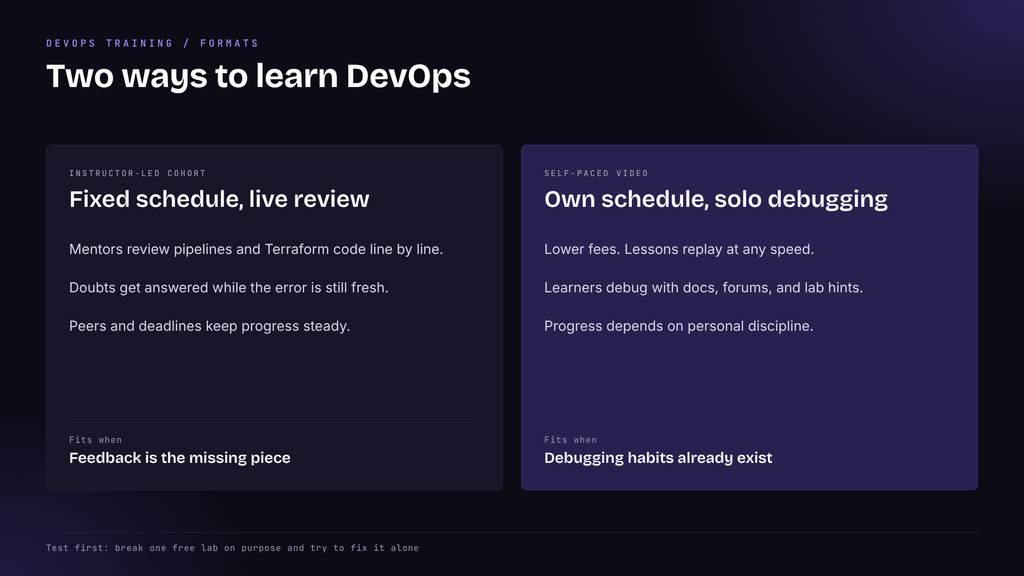
Instructor-led cohorts run on a fixed schedule. Mentors review pipelines and Terraform code line by line. Doubts get answered while the error is still fresh. Peers and deadlines keep progress steady.
Self-paced courses run on the learner’s own schedule. Fees are lower, and lessons can be replayed at any speed. Learners debug alone, using docs, forums, and lab hints. Progress depends on personal discipline. A simple test settles the choice. Take one free lab, then break something on purpose. If fixing it alone feels productive, self-paced fits. If the fix stalls for days, paid review time earns its fee.
What Tools & Technologies Are Covered in Top DevOps Courses?
Top courses teach one tool per layer and show how the layers connect. Stack Overflow’s 2026 survey shows where usage sits today. Docker leads at 59.1% of respondents. Kubernetes stands at 26% and Terraform at 18.3%.
| Layer | Tools | What Learners Should Be Able to Do |
|---|---|---|
| Source control | Git, GitHub, GitLab | Branch, review, and resolve merge conflicts |
| CI/CD | GitHub Actions, GitLab CI, Jenkins | Build, test, and gate a release |
| Containers | Docker, Docker Compose | Write small, multi-stage images |
| Orchestration | Kubernetes, Helm | Deploy, scale, and roll back workloads |
| Infrastructure as code | Terraform, OpenTofu, Ansible | Provision and configure repeatable environments |
| GitOps | Argo CD, Flux | Sync clusters from a Git repository |
| Cloud | AWS, Azure, Google Cloud | Set up IAM, networking, and managed Kubernetes |
| Observability | Prometheus, Grafana, OpenTelemetry | Alert on service-level objectives |
| Security | Trivy, Snyk, Checkov | Scan images, dependencies, and IaC before merge |
CI/CD tools teach two different operating models. Jenkins runs on a self-managed controller with plugins. GitHub Actions and GitLab CI run YAML workflows stored next to the code. Strong courses cover one tool from each model. Learners then handle both legacy and newer pipelines.
How Much Does DevOps Training Cost in India, and What’s a Fair Price?
DevOps training in India runs from free to six-figure rupee programs. Certification exams are the fixed cost, and they are priced in US dollars.
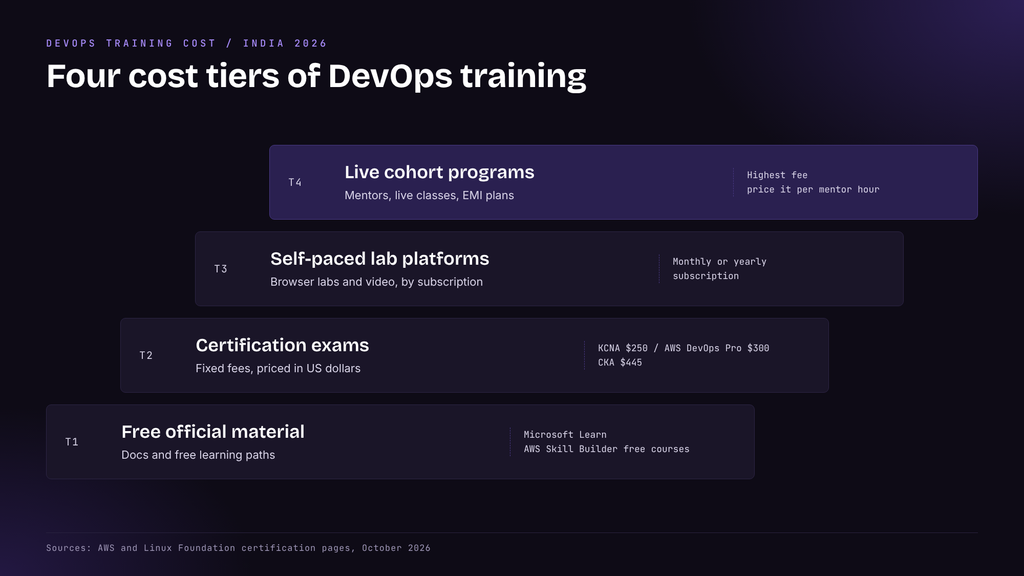
Free material covers more than most learners use. Microsoft Learn hosts free AZ-400 learning paths. AWS Skill Builder offers free digital courses. Kubernetes and Terraform publish complete official documentation.
Exam fees come next. KCNA costs $250, and the CKA costs $445. The AWS DevOps Engineer Professional exam costs $300. AWS notes that taxes and exchange rates can add to that. Microsoft prices AZ-400 by the country where the exam is proctored. Check what each fee includes. The CKA fee already covers one retake and two simulator sessions. Self-paced lab platforms charge monthly or yearly subscriptions. Live cohort programs cost the most and often offer EMI plans.
A fair price follows what the fee actually buys. First, add up the included exam vouchers and lab access. Then price the remainder per hour of mentor review. A fee with no named mentor hours mostly buys recorded content.
Does DevOps Training Include Placement Support, and Does That Actually Lead to Jobs?
Most paid programs include placement support. It usually means resume reviews, mock interviews, and referrals to hiring partners. It rarely means a guaranteed offer. The contract terms matter more than the brochure.
Indian regulators now check outcome claims closely. The Central Consumer Protection Authority acted in February 2026. It fined Vajirao and Reddy Institute ₹15 lakh. Its ads hid which courses successful UPSC candidates had taken. The same scrutiny applies to tech programs that publish salary hikes.
Ask four questions about any placement report. Which batch and course does the data cover? Does the count include every enrolled learner, or only those marked eligible? Is the salary figure a median or an average? Has an outside firm audited the numbers?
Placement support works best on top of a strong portfolio. DevOps interviews usually probe real pipelines and failure stories. A public capstone repo with a written postmortem gives interviewers both.
What to Expect in a Good DevOps Curriculum?
A good DevOps curriculum moves in phases, and each phase ships something. Expect five phases in roughly this order.
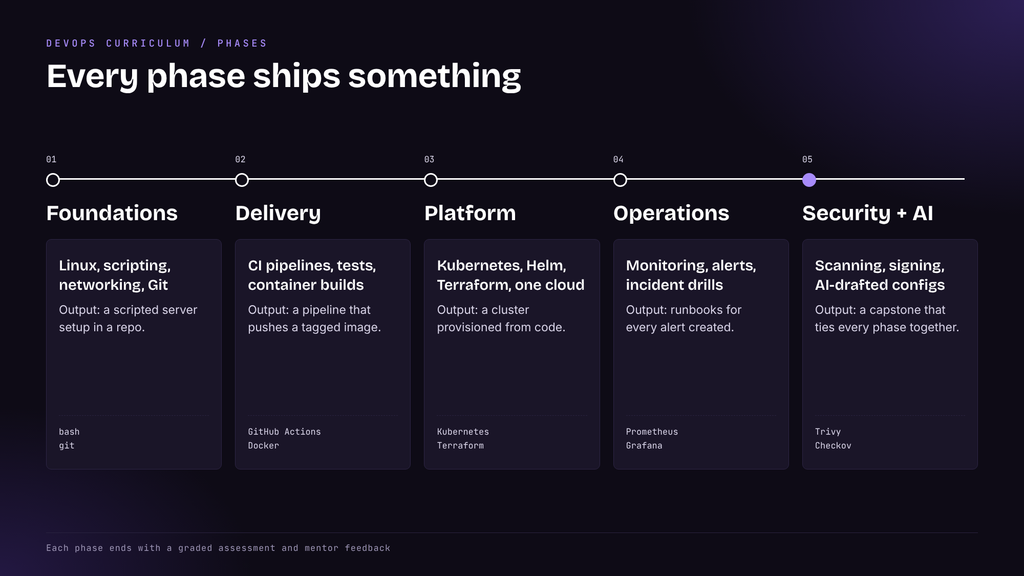
Foundations come first: Linux, shell scripting, networking, and Git. Learners finish with a scripted server setup in a repo. Delivery comes next: CI pipelines, automated tests, and container builds. The output is a pipeline that builds and pushes a tagged image. Platform work follows: Kubernetes, Helm, Terraform, and one cloud. Learners provision a cluster from code and deploy to it.
Operations closes the loop with monitoring, alerting, incident drills, and postmortems. Learners write runbooks for the alerts they create. The final phase covers security and AI-assisted operations. Learners scan images, sign artifacts, and review AI-drafted configs. Talent500’s AI roadmap for DevOps engineers lists the AI skills worth adding. Each phase should end with a graded assessment and mentor feedback. The capstone then ties every phase into one repo.
Is Corporate or Employer-Sponsored DevOps Training Different From What You’d Buy Yourself?
Yes. Corporate training targets the employer’s stack and current projects. Self-bought training targets the learner’s next role.
Employers now lean on training over hiring. The Linux Foundation’s 2026 report covers this shift. Upskilling ranked as the top talent strategy at 57%. External hiring came in at 49%. New hires take 53% longer to reach productivity. Twenty-eight percent of new hires resign within six months. Corporate programs usually teach on internal tools and real repositories. Many bundle exam vouchers and cloud sandbox accounts. Content may skip tools the company does not run.
Self-bought training stays portable. It covers the tools that most job postings ask for, across clouds. Check one detail before accepting sponsorship. Some employers attach a service bond or fee clawback to paid certifications. Read those terms before signing.
Conclusion
Start with the target role and the cloud it runs on. Then complete one free lab track and break something on purpose. That result shows whether self-paced study fits. Book the matching exam only after the capstone passes end to end. Pay for mentor time when debugging stalls for days. Judge every program by its lab hours and audited outcomes.
Frequently Asked Questions (FAQs)
These answers cover the questions learners raise most before picking DevOps training.
What Is DevOps Training?
DevOps training teaches how to build, ship, and run software with automation. It covers Linux, Git, CI/CD, containers, Kubernetes, infrastructure as code, cloud, and monitoring. Good programs teach through labs and a working capstone.
What Topics Are Covered in DevOps Training?
Core topics include Linux, scripting, Git, CI/CD pipelines, Docker, and Kubernetes. Most programs add Terraform, one major cloud, and monitoring with Prometheus and Grafana. Newer curricula add security scanning, GitOps, and AI-assisted operations.
Who Should Consider Taking DevOps Training?
Developers, system administrators, testers, and support engineers benefit most. Freshers can start too, with Linux and networking first. Working engineers often train for a certification tied to their employer’s cloud.
How Long Does It Take to Complete DevOps Training?
It depends on the starting point and weekly hours. Developers with Linux basics can reach job-ready skills in a few months. Learners starting from scratch usually need six to twelve months.
What Skills Can You Gain From DevOps Training?
Learners gain pipeline design, container builds, Kubernetes operations, and infrastructure as code. They also learn cloud IAM, monitoring, and incident response. Strong programs add scripting, structured debugging, and clear postmortem writing.