AI models are entering a new stage of development.
The competition is no longer limited to which chatbot can provide the most accurate answer. The focus is moving toward AI systems that can reason through complex problems, develop and modify software, work with enterprise information, use tools, and complete multi-step workflows.
Google’s latest AI announcement reflects this shift.
On September 30, 2026, Google introduced Gemini 4 Argon, the first model in its new Gemini 4 generation. According to Google, Argon is built for demanding workloads, with a particular focus on software engineering, enterprise knowledge work, and cybersecurity. The model has initially been made available to selected cybersecurity partners rather than released broadly.
For professionals and job seekers, however, the most important part of the announcement isn’t simply how Gemini 4 Argon performs on benchmarks.
It is what its capabilities suggest about the future of AI-enabled work.
From AI That Answers to AI That Works
The first wave of generative AI made it easier to ask questions, create content, summarize information, and generate code.
People could use AI to:
- Write emails and other business communications.
- Summarize lengthy documents.
- Generate software code.
- Analyze datasets.
- Create presentations and reports.
The next phase is significantly more ambitious.
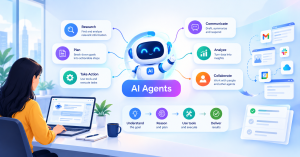
AI systems are increasingly being developed to understand an objective, break it into smaller tasks, use different tools, and work toward a completed outcome.
Google’s Gemini 4 announcement is part of this broader transition. The company says Argon can handle complex engineering and enterprise workflows, while reports surrounding the launch indicate that the model performs competitively with leading frontier models on selected coding and cybersecurity evaluations.
This matters because real-world work rarely consists of answering one isolated question.
A typical workflow looks more like:
Understand the problem → gather information → analyze → make decisions → execute → verify the result.
AI is increasingly being designed to participate across that entire process.
Software Engineering Is Changing
Software development is one of the areas where this transformation is particularly visible.
Google says its engineers are already using Gemini 4 internally, while reports around the launch indicate that Argon has been applied to large-scale engineering tasks involving Google’s codebases and infrastructure.
This doesn’t necessarily mean software engineers are becoming unnecessary.
Instead, it changes where engineers spend their time and expertise.
Rather than manually producing every line of code, developers can increasingly use AI to:
- Generate initial implementations.
- Identify and fix bugs.
- Refactor existing systems.
- Create and update tests.
- Explain unfamiliar codebases.
- Modernize legacy applications.
- Review pull requests.
- Evaluate different technical approaches.
As AI handles more implementation work, human expertise becomes increasingly important in architecture, technical judgment, validation, problem-solving, and ownership.
The developer’s role is gradually moving from simply writing code toward directing, evaluating, and improving the systems that produce it.
Cybersecurity Is Another Major AI Frontier
Google’s decision to initially make Gemini 4 Argon available to selected cybersecurity partners is also noteworthy.
More capable AI systems could help security teams:
- Identify vulnerabilities more quickly.
- Analyze large volumes of source code.
- Investigate suspicious activity.
- Support incident response.
- Automate parts of security analysis.
- Identify potential weaknesses across complex systems.
However, more powerful AI can also introduce new security challenges.
The same capabilities that help defenders analyze systems could potentially be misused by attackers. This makes controlled deployment, security testing, and responsible AI development increasingly important.
For cybersecurity professionals, this creates an increasingly valuable combination:
Cybersecurity expertise + AI fluency
Rather than treating AI knowledge as a separate specialization, professionals can integrate it directly into their existing security expertise.
What Gemini 4 Argon Means for Candidates
You don’t need to become a foundation-model researcher to benefit from the rise of increasingly capable AI.
The larger opportunity is understanding how AI can change the work you already do.
For example:
- A software engineer can learn AI-assisted development and agentic coding workflows.
- A product manager can learn how to prototype and evaluate AI-powered features.
- A cybersecurity professional can use AI for vulnerability analysis and security workflows.
- A finance professional can apply AI to reporting, research, and data analysis.
- A marketer can use AI for research, content workflows, and campaign analysis.
The common factor isn’t knowing every new AI model.
It is knowing how to apply AI effectively to meaningful business problems.
What Skills Should You Build?
As AI becomes more capable, professionals should consider developing five complementary layers of expertise.
1. AI Literacy
Understand what modern AI models can do, where they perform well, and where their limitations remain.
2. Prompting and Context Management
Learn how to provide models with the right instructions, information, constraints, examples, and context.
3. AI Tools
Become comfortable using AI applications directly within your existing professional workflow rather than treating them as standalone chatbots.
4. Integration and Automation
Develop familiarity with APIs, automation platforms, agents, and basic workflow design so AI can become part of larger business processes.
5. Domain Expertise
Understand your industry and business problem deeply enough to determine whether an AI-generated result is actually accurate, useful, and actionable.
This final layer may become increasingly important.
The value of AI isn’t simply its ability to generate an answer. The real value comes from producing an answer that can be evaluated, trusted, and applied effectively.
What Does This Mean for Your Career?
The rise of increasingly capable AI models doesn’t mean that every profession will suddenly become an AI profession.
Instead, more existing roles are likely to become AI-enabled.
Professionals who combine strong domain knowledge with AI capabilities may be able to:
- Automate repetitive work.
- Take on more complex assignments.
- Analyze larger amounts of information.
- Make faster decisions.
- Improve productivity.
- Build new products and workflows.
So instead of asking:
“Will Gemini replace my job?”
A more useful question is:
“What could I accomplish differently if I had a highly capable AI assistant working alongside me?”
That shift in perspective is where the career opportunity begins.
The Talent500 Takeaway
AI models are becoming increasingly capable of reasoning, coding, analyzing information, and completing complex workflows.
Your competitive advantage doesn’t necessarily have to come from competing with these systems.
It can come from learning how to work effectively with them.
The professionals who understand both their domain and the capabilities of AI will be better positioned to adapt as work continues to evolve.
As AI moves from answering questions to completing increasingly complex tasks, the ability to combine technical or domain expertise with AI fluency could become one of the most valuable career advantages.
Ready to build an AI-ready career?
Explore emerging technology roles and AI-enabled opportunities on Talent500.
→ Explore AI jobs on Talent500
Read more such articles from our Newsletter here.