Key Summary
AI in DevOps is the use of machine learning, LLMs, and agents across the delivery lifecycle. It covers code, pipelines, testing, monitoring, and incident response. AWS and Microsoft made incident-investigation agents generally available in 2026. These agents investigate incidents in minutes. Humans still approve every production fix. The gains are real but uneven. DORA’s 2026 ROI report models an early productivity dip. AI-written code still fails security checks in about 44% of cases. Teams see the best results in test selection, migrations, and incident triage. Read-only agents come first. Write access follows proven accuracy.
What is meant by AI in DevOps?
AI in DevOps means applying models across the full delivery lifecycle. The scope runs from code and pipelines to infrastructure and incident response. Two distinct technologies sit under this label. The first is classic machine learning. It learns statistical baselines from metrics, logs, and traces. Then it flags deviations and predicts likely failures. This layer has powered AIOps platforms for years.
The second is generative AI built on large language models. It reads code, configs, runbooks, and incident timelines. Then it writes drafts, summaries, and remediation plans. The newest shift is agentic AI. Agents chain tool calls together to finish multi-step tasks. An agent can query Grafana, read a diff, and open a pull request. Adoption is climbing fast. Stack Overflow’s May 2026 pulse survey put workplace agent use at 59%. That figure was 31% a year earlier.
How Is AI Useful For DevOps Teams?
AI earns its place where delivery work is high-volume and pattern-driven. The seven areas below show where that holds today. Each one includes the evidence and the tooling behind it.
1. Smarter CI/CD Workflows
Test suites grow faster than CI budgets. Predictive test selection addresses this directly. A model studies historical test results against the files each change touches. It then runs only the tests most likely to fail.
The method is mature, not experimental. Meta proved it at monorepo scale. Its system ran about a third of dependency-selected tests. It still caught over 99.9% of faulty changes. Testing infrastructure cost dropped by half. Teams also use LLMs to draft and debug GitHub Actions and GitLab CI files. AI also summarizes failed build logs into a probable cause.
2. Automated Code Quality and Security Analysis
AI reviewers now comment directly on pull requests. Tools like CodeRabbit and GitHub Copilot code review flag bugs and risky patterns.
This review layer matters because AI-written code carries real risk. Veracode’s July 2026 report tracked over 100 models across four testing snapshots. The average security pass rate held at 56%. That number barely moved across a year of model releases. Reasoning models do slightly better, at 56% versus 51%.
The fix is layered review, not blind trust. Run AI review on merges into dev branches. Keep a human approver and SAST tools like Snyk Code on main.
3. Monitoring and Incident Alerting by AI
Alert fatigue remains the core operations problem. PagerDuty research, cited by DevOps.com in 2026, puts actionable alerts at about 3%. AIOps engines group related alerts into one incident. They also suppress duplicates and known noise.
The bigger shift is the AI SRE agent. Datadog’s agent starts investigating the moment an alert fires. It forms root-cause hypotheses, validates them, and posts conclusions to chat. A 2026 upgrade made it roughly twice as fast. It also added an agent trace showing every query it ran. On-call engineers can audit the reasoning, not just the answer.
4. Predictive Analytics for Performance and Reliability
ML models learn each service’s seasonal traffic and resource patterns. Datadog Watchdog and Dynatrace Davis flag drift before SLOs break. Teams feed these forecasts into capacity planning and autoscaling thresholds.
Agents now extend prediction into prevention. AWS DevOps Agent reviews recent incidents to recommend reliability fixes. It reached general availability on March 31, 2026. The goal is fewer repeat incidents, not just faster recovery.
5. Intelligent Testing and Self-Healing Pipelines
Test generation works when AI output must prove itself. Meta’s TestGen-LLM set a widely cited template for this. Every candidate test must build, pass repeatedly, and raise coverage. Tests that fail any filter are discarded automatically. Only survivors reach a human reviewer.
That filter design is the real lesson. AI output becomes a candidate, and the pipeline decides what ships. The same logic handles flaky jobs. AI retries known flaky steps and quarantines repeat offenders. Engineers then see only failures that point to real defects.
6. Self-Healing Infrastructure
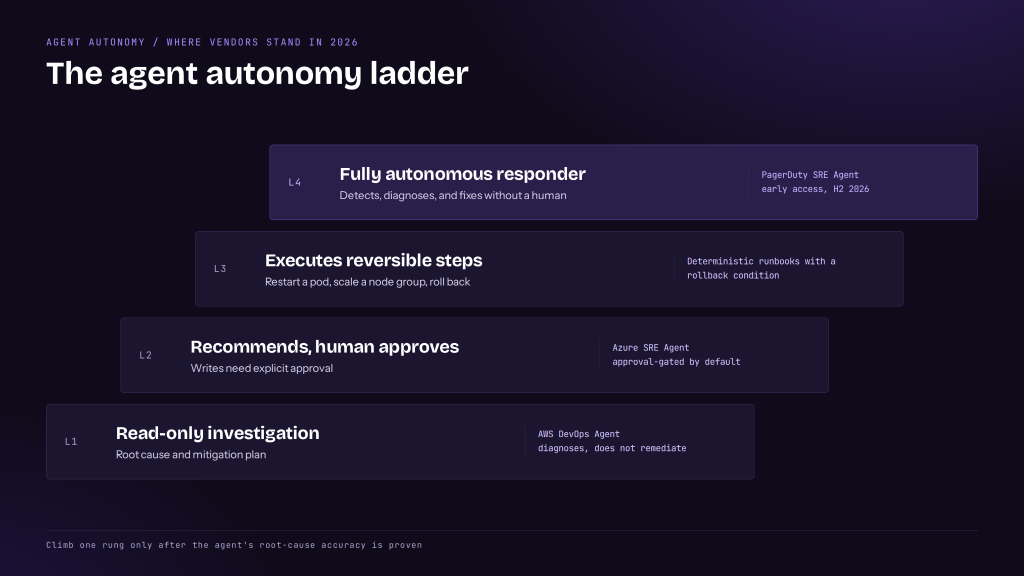
Self-healing works best when the fix is deterministic. Each known alert maps to a runbook step and a rollback condition. AI executes only the reversible part, like restarting a pod. Irreversible actions route to a human.
Major vendors draw the same line today. By default, Azure SRE Agent needs human approval for any write action. AWS DevOps Agent diagnoses and recommends but does not remediate on its own. PagerDuty plans fully autonomous responders in early access for H2 2026. Start with read-only modes and expand scope slowly.
7. AI-Driven Security
Security tooling is now part of the attack surface. In March 2026, attackers compromised Trivy and its GitHub Actions. LiteLLM’s pipeline ran an unpinned Trivy action during a build. The poisoned scanner stole LiteLLM’s PyPI token. Backdoored LiteLLM releases reached PyPI within five days.
AI helps on both sides of this problem. Assistants review Terraform for open security groups and missing tags. Policy engines like OPA and Checkov stay the final gate. Pin actions to commit SHAs and sign artifacts with Sigstore. Compliance teams also run agents that collect audit evidence against controls.
Explain How Can a DevOps Team Take Advantage of Artificial Intelligence With a Simple Example
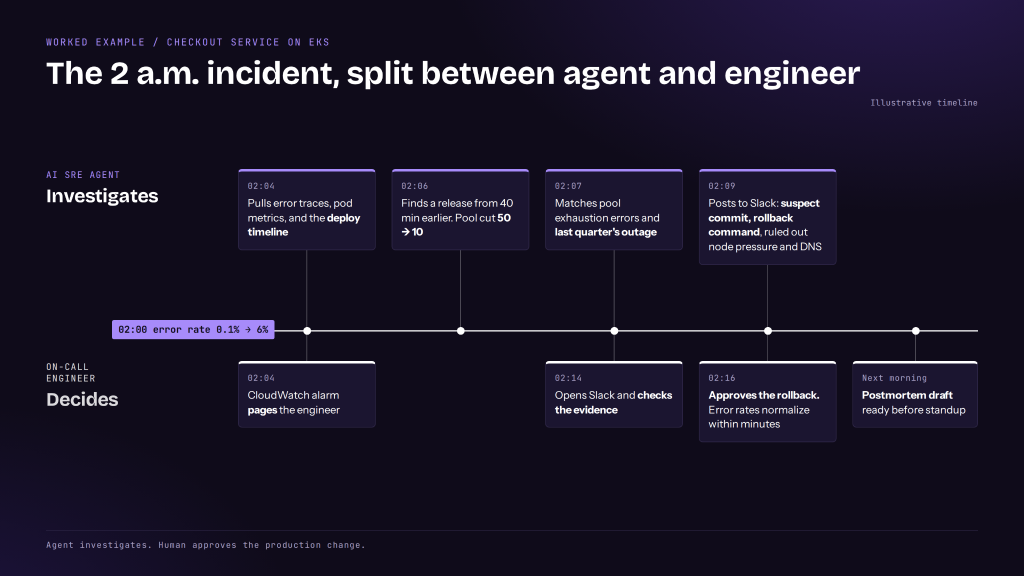
Consider a checkout service on EKS at 2 a.m. Error rates jump from 0.1% to 6% in four minutes. A CloudWatch alarm fires and pages the on-call engineer. An AI SRE agent starts work at the same moment. It pulls error traces, pod metrics, and the deploy timeline. A release shipped 40 minutes earlier. That release cut the database connection pool from 50 to 10. The agent finds pool exhaustion errors in the application logs. It also links a similar change to last quarter’s outage.
Next, it posts a summary in the incident Slack channel. The summary names the suspect commit and the rollback command. It also lists what it ruled out, like node pressure and DNS. The engineer opens Slack, checks the evidence, and approves the rollback. Error rates normalize within minutes. The postmortem draft is ready before standup. This split of labor reflects current tooling. One analysis of AWS DevOps Agent found investigation now takes minutes. Most remaining resolution time is the human loop of waking, verifying, and acting.
When and Why Would I use How Can a DevOps Team Take Advantage of Artificial Intelligence in Real Code?
Use AI where output is repetitive and easy to verify. Terraform modules, Helm charts, and Kubernetes manifests fit well. Practitioners on r/devops report IaC drafts landing about 80% complete. Engineers then review instead of writing from scratch.Large migrations are the strongest proven case. Google’s May 2026 paper reports AI fully authored 80% of migration code changes. Total migration time fell by about 50%.
In one migration, about 87% of AI code shipped without human edits. Review, not generation, became the bottleneck. Jenkins-to-GitHub Actions ports follow the same pattern at smaller scale. Internal tooling is another fit. Many teams build an MCP server over their observability stack. Developers then query logs in plain English instead of a vendor query language. Avoid AI-first changes in auth, network policy, and stateful data layers. Errors there are expensive and hard to roll back.
What are the Common Mistakes People Make with How A Devops Team Takes Advantage of Artificial Intelligence?
1. Rewarding usage instead of outcomes
Some orgs now rank engineers by AI token consumption. DORA warned in June 2026 that this “tokenmaxxing” is a trap. Track lead time, change failure rate, and MTTR instead.
2. Ignoring the verification tax:
AI cuts start-up friction on new code. But DORA’s March 2026 guidance flags heavy verification overhead downstream. Budget review capacity before scaling AI-generated pull requests.
3. Granting write access too early :
Agentic projects fail when access arrives before governance. A July 2026 Forbes analysis ties cancellations to missing ownership and rollback controls. In Gartner’s 2026 security survey, 49% of security leaders flagged agentic AI. Keep agents read-only until their recommendations prove accurate.
4. Trusting “almost right” output:
Near-correct output is the most expensive kind. In Stack Overflow’s May 2026 pulse, accuracy and security still topped agent concerns.
5. Feeding poor context :
Stale runbooks and missing service maps produce confident, wrong answers.
6. Leaking data:
Strip PII and secrets before logs reach an external model.
What is AIOps and How Does It Differ From Traditional DevOps Monitoring?
AIOps applies machine learning to operations data at scale. Traditional monitoring runs on static rules. An engineer sets CPU above 80% as an alert trigger. That rule fires during every normal traffic peak. It also stays silent while a slow memory leak builds below threshold. AIOps learns a baseline for each service instead. It alerts on deviations from that baseline, including slow drifts. It also correlates alerts across services into one incident.
Traditional tools show symptoms on separate dashboards. AIOps points toward a probable root cause. The 2026 version adds a reasoning layer on top. LLM agents read the correlated incident, query more data, and explain findings. Classic AIOps answers what is abnormal. Agentic AIOps also attempts to explain why.
Will AI Reduce the Number of DevOps Engineers Teams Need?
Current data points to a shift in work, not a cut in headcount. Robert Half’s 2026 analysis lists DevOps engineers among the most in-demand tech roles. AI clearly cuts toil. Boilerplate YAML, log triage, and runbook drafts take far less time. But every AI change still needs review and ownership. The role is moving toward platform engineering and agent supervision. Engineers now design agent permissions, evaluation suites, and rollback paths. That work requires deeper systems knowledge, not less.
Which are the Best AI Tools for DevOps Teams?
The right stack depends on where your team loses the most hours. Most teams combine three layers: coding, observability, and incident response.
| Tool | Layer | Best For |
| GitHub Copilot | Coding | IaC, scripts, pipeline YAML, and PR review |
| Claude Code | Coding agent | Multi-file refactors and legacy migrations |
| CodeRabbit | PR review | Line-level pull request feedback |
| Snyk Code | Security | SAST findings with fix suggestions |
| Datadog Bits AI SRE | Incident agent | Autonomous alert investigation with an auditable agent trace |
| AWS DevOps Agent | Incident agent | Root cause analysis across AWS, multicloud, and on-prem, GA since March 2026 |
| Azure SRE Agent | Incident agent | Azure diagnostics with approval-gated actions |
| PagerDuty AIOps | Alert correlation | Noise reduction, triage, and SRE agent workflows |
| Dynatrace Davis | AIOps | Causal root cause analysis |
| k8sgpt | Kubernetes | Cluster diagnostics in plain English |
Frequently Asked Questions (FAQs)
These answers cover the questions teams raise most during AI pilots. Each one points back to the evidence in the sections above.
1. How can AI be used in DevOps?
AI drafts IaC, reviews pull requests, and selects which tests to run. In production, it detects anomalies and correlates related alerts. Agents now investigate incidents and propose fixes for human approval.
2. Can DevOps be taken over by AI?
No. AI automates investigation, drafting, and repetitive pipeline work. Major AI SRE agents still keep humans as the approval gate. System design and accountability stay with engineers.
3. Which AI is better for DevOps?
No single tool wins every layer. Copilot and Claude Code lead for code and IaC. Datadog, Dynatrace, and PagerDuty lead for observability and AIOps. Choose cloud-native agents if you run mostly on AWS or Azure.
4. How to use AI agents in DevOps?
Start with read-only agents for incident triage. Connect them to logs, metrics, deploy history, and runbooks through MCP. Measure their root-cause accuracy over a few weeks. Then allow write actions only for reversible, tested runbook steps.
5. How can AI help with monitoring and incident management?
AI groups related alerts into single incidents and suppresses noise. It flags anomalies against learned baselines rather than static thresholds. Agents then gather evidence, suggest root causes, and draft postmortems.