India’s Global Capability Centre (GCC) ecosystem is entering a new phase. For years, the growth of GCCs in India was largely driven by scale. Global companies expanded their teams, moved technology operations to India, and increasingly used the country as a hub for business and operational support.
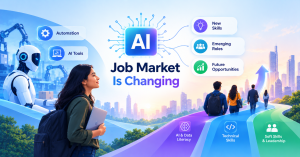
That model is now evolving. Companies are increasingly focused on building specialised capabilities, particularly in artificial intelligence, data, software engineering, digital products, and advanced technology. A recent ANSR analysis of more than 5,000 active GCC job openings and over 20,000 roles filled during the past year offers a clear view of this changing hiring landscape. One finding stands out: nearly 65% of new GCC roles created in 2026 require AI skills. At the same time, demand for AI and data professionals has grown by approximately 45% year over year. For professionals looking to build careers with multinational companies in India, this shift is becoming increasingly difficult to ignore.
GCC Hiring Is Moving From Headcount to Capability
The traditional GCC growth strategy was largely built around scale. More employees meant more work could be delivered from India. The emerging model is different. Companies are increasingly interested in capability density — building teams with specialised skills that can solve complex problems and create strategic value. According to ANSR, GCC hiring grew by approximately 12–15% year over year during the first half of 2026, outpacing the broader IT and IT-enabled services sector. However, it isn’t just the volume of hiring that is changing. The types of capabilities companies want are changing as well. Employers are increasingly looking for professionals who can:
- Develop AI-powered applications.
- Work with structured and unstructured data.
- Deploy and manage AI systems.
- Integrate technology into business workflows.
- Build and manage digital products.
- Solve complex business and operational problems.
This explains why AI skills are increasingly appearing in job descriptions even when “AI” isn’t part of the job title.
You Don’t Need an AI Job Title to Need AI Skills
Consider two software engineers. One has strong programming skills and can independently build applications. The other has the same software engineering foundation but can also use AI coding tools, integrate LLM APIs, develop RAG applications, and automate parts of the software development lifecycle. The second profile represents where many technology roles are heading. The same shift is happening across other functions.
Product Managers
Product professionals increasingly need to understand AI capabilities, limitations, evaluation methods, user experience, and how AI features can create business value.
Data Professionals
Data teams are working more frequently with AI pipelines, unstructured information, vector databases, and model-powered applications.
Cybersecurity Professionals
AI is becoming both a security tool and a technology that organizations need to secure and govern.
Finance Professionals
AI can support financial analysis, reporting, document processing, forecasting, and other data-heavy workflows.
Operations Professionals
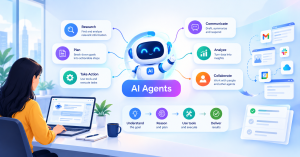
AI agents and automation platforms are increasingly capable of handling multi-step operational processes. The common thread is simple:
AI is becoming a capability layered on top of existing professional expertise.
The Rise of the Forward Deployed Engineer
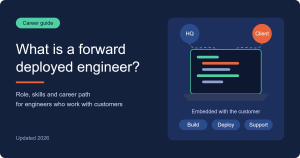
One of the clearest examples of this shift is the growing demand for the Forward Deployed Engineer (FDE). According to ANSR, postings for Forward Deployed Engineers and AI engineering roles increased by approximately 1,000% over the previous 12 months. The role sits at the intersection of technology, business, and customer needs. A Forward Deployed Engineer may be responsible for:
- Understanding a business or customer problem.
- Designing an AI-enabled solution.
- Building an initial prototype.
- Connecting the solution to existing systems.
- Testing its performance.
- Deploying it in a real environment.
- Improving it based on user feedback and results.
This is very different from developing technology in isolation. It requires strong technical skills combined with business understanding, communication, and problem-solving ability.
Experience Is Becoming More Important
Another notable finding from the ANSR analysis is the concentration of GCC hiring among mid-career professionals. The median experience level is approximately six years, while around 62% of hiring is concentrated among candidates with three to eight years of experience. This doesn’t mean fresh graduates are being excluded from GCC opportunities. However, it does suggest that candidates may need to demonstrate specific, job-ready capabilities rather than depending only on academic qualifications or broad technical knowledge. For early-career professionals, practical projects can therefore become an important differentiator.
Instead of simply writing:
“Interested in AI.”
A stronger profile could demonstrate:
“Built a RAG-based application using enterprise documents.”
Or:
“Developed an AI agent that automates a multi-step business workflow.”
The difference is evidence.
Employers increasingly want to see what you can build, automate, integrate, or solve.
What Skills Should Candidates Build?
A practical AI career stack can be divided into five layers.
1. Technical Foundation
Build strong fundamentals in:
- Python
- SQL
- APIs
- Cloud platforms
2. AI Application Skills
Learn technologies such as:
- Large language models (LLMs)
- Retrieval-augmented generation (RAG)
- Vector databases
- Prompt engineering
3. AI Agent Skills
Understand:
- Tool calling
- Workflow orchestration
- Agent frameworks
- Multi-step AI workflows
4. Production Skills
Learn how to move AI applications beyond prototypes through:
- Deployment
- Monitoring
- Evaluation
- Security
- Reliability
5. Business Skills
Develop capabilities in:
- Problem-solving
- Communication
- Business understanding
- Domain expertise
You don’t need to master all five layers at once.
A better approach is to start with the layer closest to your current expertise and gradually expand your skill set.
What Does This Mean for Your Career?
The GCC market isn’t simply becoming an “AI job market.” Instead, it is becoming a market where AI capabilities are increasingly embedded into existing roles. This creates two potential career paths.
Strategy 1: Become an AI Specialist
Build deep expertise in areas such as:
- AI engineering
- Machine learning
- AI agents
- AI architecture
Strategy 2: Become an AI-Enabled Domain Specialist
Combine your existing professional expertise with strong AI capabilities. For many professionals, the second path may be more accessible. A finance professional doesn’t necessarily need to become a machine learning researcher. A product manager doesn’t need to train foundation models. A recruiter doesn’t need to become a software engineer. Instead, they need to understand how AI can improve and transform the work they already know.
The Talent500 Takeaway
The question for candidates is no longer simply:
“Do I work in AI?”
The more important question is:
“How much AI capability does my role require, and how strong am I at using it?”
As GCCs move toward capability-driven hiring, professionals who combine domain expertise with AI skills are likely to be better positioned for emerging opportunities.
The sooner candidates begin building this combination, the better prepared they can be for the next phase of India’s GCC ecosystem.
Looking for your next GCC opportunity?
Explore technology, product, AI, and business roles from leading global companies on Talent500.
→ Explore GCC jobs on Talent500
Read more such articles from our Newsletter here