Key Summary
A DevOps architect designs the delivery system a company’s engineers use daily. The role covers pipelines, infrastructure, cloud platforms, security, and observability. A developer merges a fix. The pipeline builds it, scans it, and rolls it out to a canary. The architect designed every step of that path.
CNCF’s January 2026 survey found 82% of container users run Kubernetes in production. Architects now design platforms around that default. Most architects arrive after 8 to 12 years of hands-on work. DORA’s May 2026 report says AI returns depend on platform quality. That makes the architect’s design work a business lever.
Who is a DevOps Architect?
A DevOps architect is the senior engineer who designs how code reaches production. The role sets the toolchain, pipeline standards, and infrastructure patterns. Developers, operations staff, and security teams all build on those choices. The architect owns the design. Engineers own the daily tickets. Both groups depend on the same shared platform.
Roles and Responsibilities of DevOps Architect
Five responsibilities define the job. Architecture comes first. The architect designs the infrastructure, the toolchain, and the release process. Integration follows. Repositories, build servers, test frameworks, and monitoring must work as one system. Automation covers testing, deployment, and rollback. Observability closes the loop. The architect decides which metrics, logs, and traces every service must emit. Collaboration ties the work together. Architects run design reviews and mentor teams. They keep the platform roadmap aligned with business goals.
What Does a DevOps Architect Actually Do Day to Day?
A DevOps architect spends most days on design decisions and unblocking teams. Mornings start with reviews. The architect checks pull requests that change shared Terraform modules or pipeline templates.
Midday brings a design session for a new service. Which cluster hosts it? Which rollout strategy fits? Which alarms must exist before launch? The architect records each answer in a short architecture decision record.
Afternoons go to reliability and cost. The architect reads incident reviews and fixes the pattern behind repeat failures. Cost questions arrive too. FinOps Foundation’s February 2026 survey found 98% of respondents manage AI spend. Architects set the tagging and budget guardrails that make that spend visible. Each week, the architect also reviews four delivery metrics. They are deploy frequency, lead time, change failure rate, and recovery time. Trends in those numbers decide what to fix next.
Stakeholder time fills the gaps. The architect meets product leads on release risk. They meet security on policy changes. They meet finance on cloud bills. Each meeting ends with a written decision.
What Are the Top Skills Needed to Be a DevOps Architect?
Six skill groups separate architects from senior engineers. Cloud design comes first. That covers account layouts, networking, and failure domains. Know one major cloud deeply. Infrastructure as code and containers come next. Stack Overflow’s October 2026 survey tracks usage among 10,889 cloud developers. Docker leads at 59.1%. Kubernetes follows at 26.0%, and Terraform at 18.3%.
Pipeline design covers build, test, and release flow. Observability and security complete the technical set. The sixth group is communication. Architects explain the same trade-off to executives and junior engineers. Depth matters more than a long tool list. Pick one cloud, one orchestrator, and one IaC tool. Go deep on each. Then learn how they fail. Failure modes separate architects from engineers who only follow tutorials.
What Skills and Salary Should I Expect for DevOps Architect in India Right Now?
Employers expect cloud design, Kubernetes, Terraform, and CI/CD depth. Glassdoor India lists average base pay at ₹25 lakh. The typical range runs from ₹18 lakh to ₹31.5 lakh. Bengaluru averages ₹29 lakh in 2026 submissions. Total pay runs higher.
Instahyre’s May 2026 data covers architects at consulting firms and capability centers. Those roles pay ₹50 lakh to ₹85 lakh in total compensation. They ask for 8 to 12 years of experience. Base pay and total pay differ. Compare offers on the same basis. Ask whether bonus and equity sit inside the figure.
How Many Years of Experience Do You Need to Move Into a DevOps Architect Role?
Most DevOps architects reach the role after 8 to 12 years. Instahyre’s May 2026 data places consulting and capability-center architects in that band. Recent Glassdoor India submissions sit mostly in two ranges. Those are 7 to 9 years and 10 to 14 years.
Scope matters more than the calendar. Show it in your portfolio. List the platforms you designed and the migrations you led. Add the incidents your design prevented. A typical path runs through three phases. Years one to four build hands-on skills. Years five to eight add ownership of a platform. Years nine and later add cross-team design and mentoring.
What Does a DevOps Architect Do That a DevOps Engineer Doesn’t?
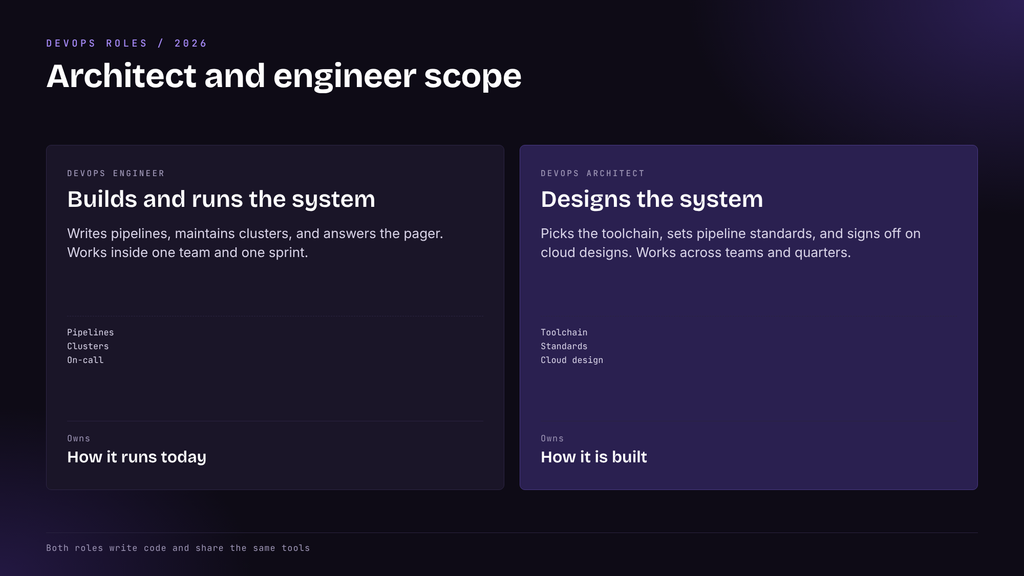
A DevOps architect decides how the delivery system is built. A DevOps engineer builds and runs it. The architect picks the toolchain and sets pipeline standards. The architect also signs off on cloud designs. The engineer writes the pipelines, maintains the clusters, and answers the pager. The architect works across teams and quarters. The engineer works inside one team and one sprint. Both roles write code and share the same tools. Their scope differs.
A short example shows the split. A release fails in production. The engineer rolls back and finds the cause. The architect asks why the pipeline allowed it. Then the architect changes the design so it cannot repeat.
What’s the Salary Difference Between a DevOps Engineer and a DevOps Architect in India?
Architects earn about three times the average engineer base pay on Glassdoor India. Engineers average ₹7 lakh to ₹9 lakh. Architects average ₹25 lakh. Experience explains part of that gap. Instahyre’s May 2026 data compares the roles more evenly. Senior engineers with 8 to 11 years earn ₹38 lakh to ₹65 lakh. That is total pay. Architects at consulting firms and capability centers earn ₹50 lakh to ₹85 lakh. The premium is ₹12 lakh to ₹20 lakh at the band edges.
How to Become a DevOps Architect in 2026?
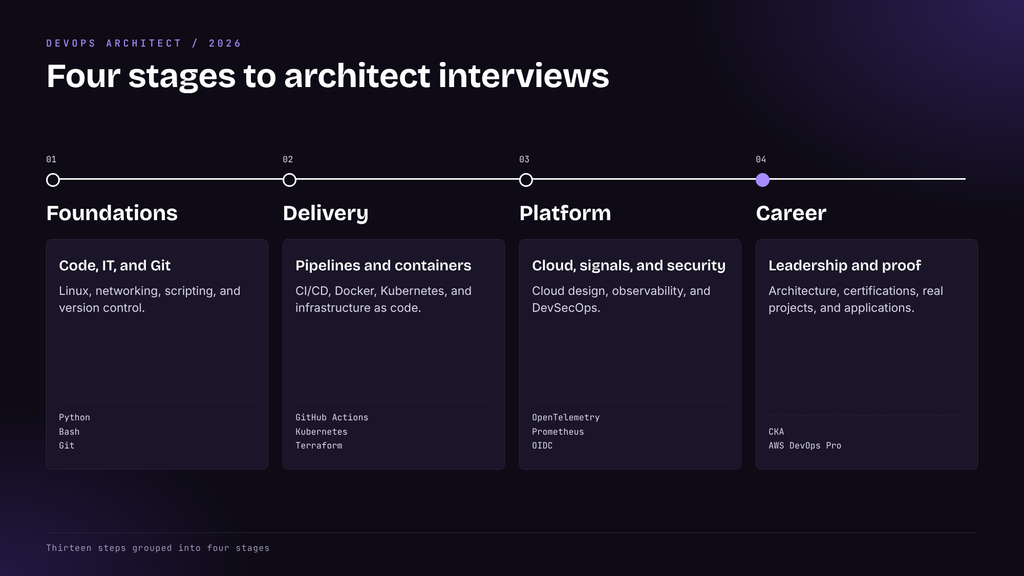
Thirteen steps take a learner from fundamentals to architect interviews. Four stages group them. Foundations come first. Delivery skills follow. Platform skills add depth. Career steps close the path.
Learn the Basics of Coding and IT
Learn Linux, networking, and one scripting language. Python and Bash cover most automation. Know how DNS, TCP, and TLS work. Architects debug across layers, so shallow basics show up later. Spend month one on Linux commands, shell scripts, and one small automation.
Understand What DevOps Means
DevOps joins development and operations through shared ownership and automation. Study the lifecycle from plan to monitor. Talent500’s DevOps lifecycle guide walks through each stage and its tools. Learn the four delivery metrics too.
Learn Git and Version Control
Master branching, rebasing, and pull request review. Adopt trunk-based development. Turn on branch protection and signed commits. GitHub’s Octoverse reports a shift in review work. Developers started over 40% of pull requests with agents by September 2026.
Set Up CI/CD (Continuous Integration/Delivery)
Build a pipeline in GitHub Actions or GitLab CI. Run tests, a security scan, and a container build on every merge. Add a staged rollout with automatic rollback. The pipeline is the architect’s main product.
Learn Docker and Kubernetes
Package a service in Docker with a multi-stage build and a non-root user. Deploy it to Kubernetes with Helm. Learn Deployments, Services, ingress, and RBAC. Kubernetes 1.36 stays supported until June 2027, so practice on a current release.
Use Infrastructure as Code
Write infrastructure in Terraform and review it like application code. The first snippet pins the provider and stores state in S3 with locking. It then builds a VPC.
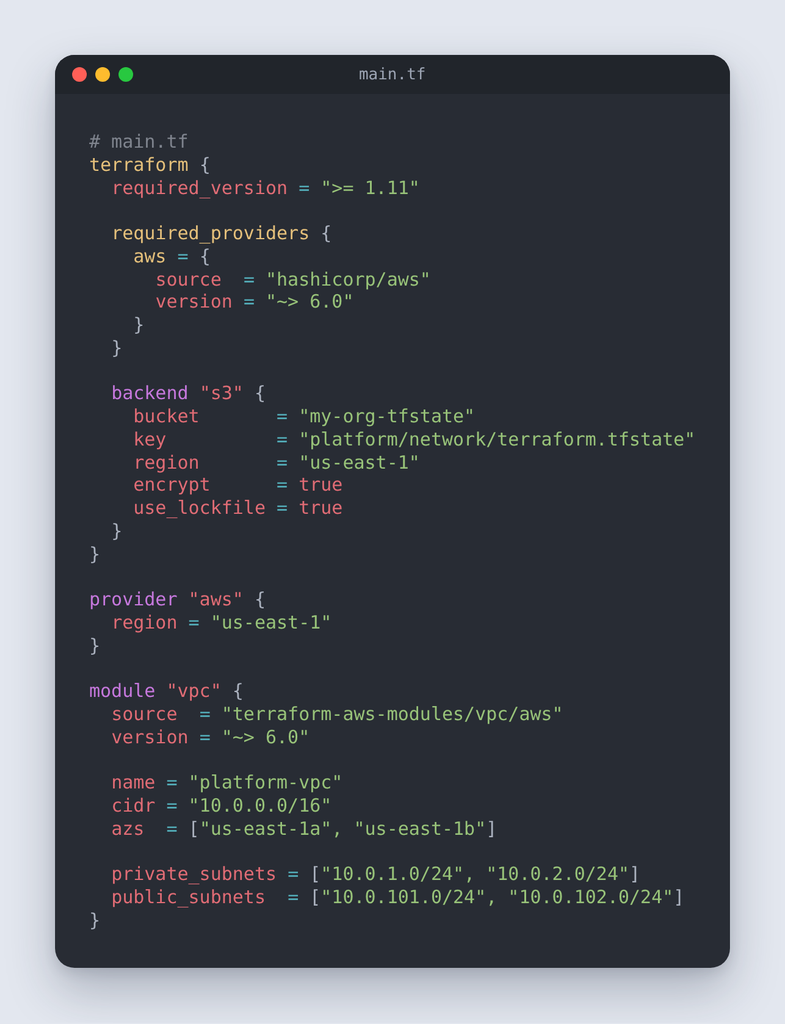
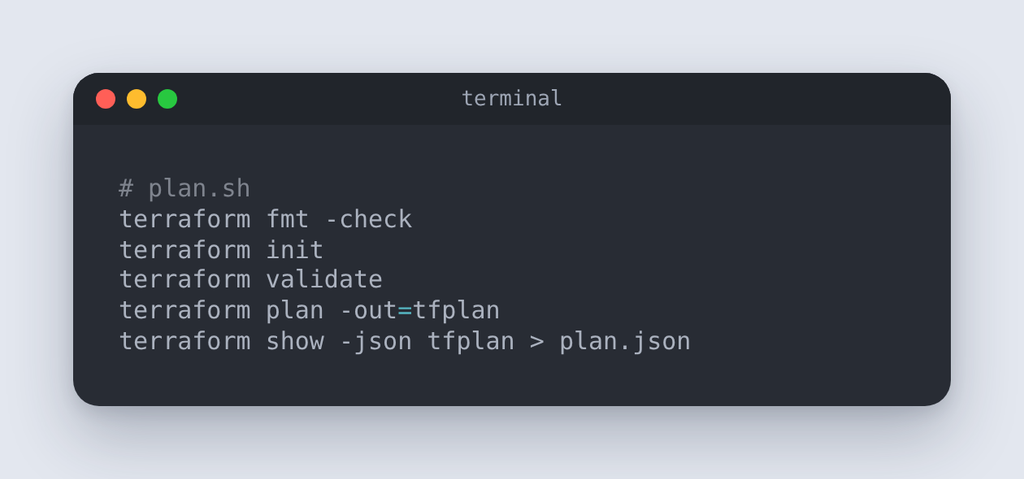
Run the commands below in order. They check format, validate the code, and save a plan for review. Replace the bucket name and CIDR ranges with your own. Add a policy check such as OPA or Checkov before apply.
Learn About Cloud Platforms
Pick one cloud first, then map its services to the others. Synergy Research data for Q3 2026 puts Amazon at 26%. The quarterly market totals $167.7 billion. Learn networking, IAM, and multi-account design before anything else. Practice least-privilege roles from day one.
Monitor Your Apps
Set up metrics, logs, and traces with OpenTelemetry, Prometheus, and Grafana. Define SLOs and alert on error-budget burn. Grafana Labs’ October 2026 survey polled 300 IT leaders. It found 85% accept AI incident investigation. Only 50% accept AI deploying to production. Start agents read-only.
Learn DevSecOps (Security in DevOps)
Scan code, images, and dependencies in the pipeline. Then secure the pipeline itself. On March 19, 2026, attackers hijacked 76 of 77 Trivy Action version tags. Aqua Security published the advisory. Pin actions to full commit SHAs. Use short-lived OIDC credentials instead of stored keys.
Improve Architecture & Leadership Skills
Study multi-region failover, blue/green releases, and platform golden paths. Gartner’s May 2026 Hype Cycle frames platform engineering as a self-service developer portal. Write architecture decision records. Present trade-offs to non-engineers. Mentor one junior engineer.
Get Certified
Pick certifications that match your cloud. The AWS Certified DevOps Engineer Professional exam runs 180 minutes. It has 75 questions and costs $300. The Linux Foundation’s CKA is a 2-hour hands-on exam at $445. Microsoft retires AZ-400 on February 1, 2027. Its AZ-401 Agentic DevOps exam is in beta.
Get Real Experience
Build projects that mirror production. Migrate a service to Kubernetes. Replace manual deploys with a pipeline. Rebuild a staging environment from Terraform. Run one project on a free cloud tier. Tear it down with Terraform. Talent500’s DevOps projects guide lists ideas from beginner to advanced. Document each project with a diagram and a decision record.
Apply for DevOps Architect Jobs
Target titles such as DevOps architect, cloud architect, and platform architect. Lead your resume with outcomes. Use deploy frequency, change failure rate, and cost saved. Prepare for a system design round. Expect questions on rollout strategy, multi-region design, and incident handling.
What Is the Career Path for a DevOps Architect?
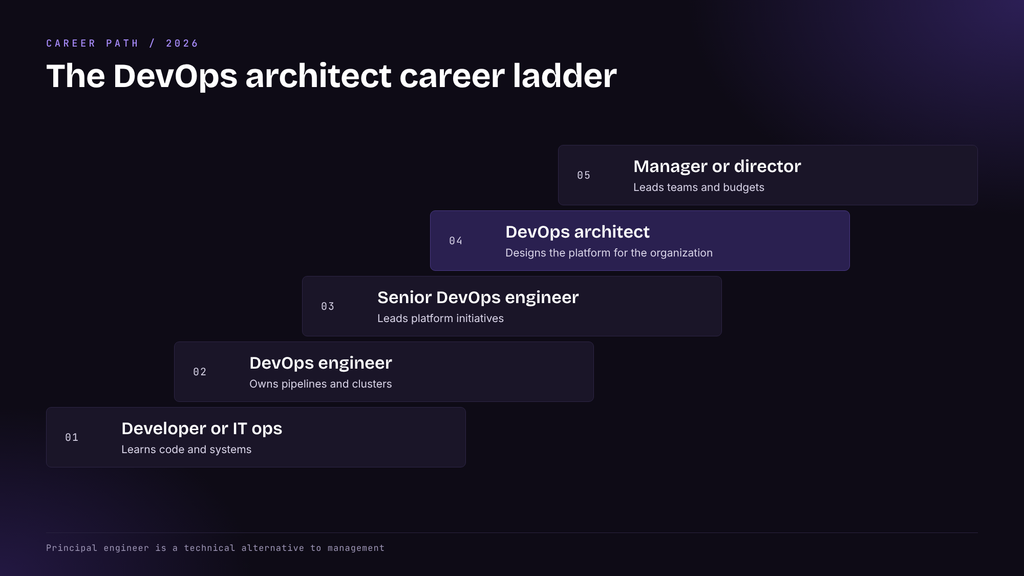
Most architects climb a five-step ladder. Each step widens scope. Junior developers and operations staff learn code and systems. DevOps engineers own pipelines and clusters. Senior engineers lead platform initiatives. Architects design the platform for the whole organization. Some then move into manager or director roles and lead teams. Others stay on the architect track as principal engineers. Principal and staff titles sit on the technical track. Manager and director titles sit on the people track. Choose based on whether you prefer design work or team building.
Turn Learning into Career Growth
Learning compounds when each step leaves proof. Publish one project per step. Pair each certification with a build that uses it. Share design write-ups on GitHub or a blog. Track numbers from your own systems. Good ones are deploy time, failure rate, and cost per environment. These artifacts carry weight in architect interviews.
Conclusion
Start this week with four actions. Build one Terraform-managed environment and deploy a containerized service to it. Book one exam that matches your cloud. AWS DevOps Engineer Professional and CKA are two options. Write one architecture decision record for a system you run today. Log deploy frequency, failure rate, and cost every quarter.
Frequently Asked Question (FAQs)
These answers cover the questions candidates raise most about the DevOps architect role.
1. What Is a DevOps Architect?
A DevOps architect is a senior engineer who designs an organization’s delivery system. The role covers toolchains, pipelines, infrastructure, security, and observability. Most architects have 8 to 12 years of experience.
2. What Does a DevOps Architect Do?
A DevOps architect reviews designs, sets pipeline and infrastructure standards, and unblocks teams. The role also covers incident patterns and cost guardrails. Daily work centers on decisions, not tickets.
3. What Skills Are Required to Become a DevOps Architect?
Cloud design, Kubernetes, Terraform, CI/CD, observability, and security form the technical core. Communication and mentoring matter equally. Certifications such as AWS DevOps Engineer Professional or CKA confirm those skills.
4. How Is a DevOps Architect Different from a DevOps Engineer?
A DevOps architect designs the system and sets standards across teams. A DevOps engineer builds, runs, and fixes the system inside a team. Architects also earn more, with scope to match.
5. What Is the Average Salary of a DevOps Architect?
Glassdoor India lists average base pay at about ₹25 lakh. Consulting firms and capability centers pay ₹50 lakh to ₹85 lakh total. That figure comes from Instahyre’s May 2026 data.