
From banking and healthcare to entertainment and e-commerce, mobile apps are at the heart of the contemporary digital economy. Because of this, the need for qualified mobile developers will only increase in 2026.
If you’re wondering how to become a mobile developer, the answer is to follow a methodical path that incorporates modern tools, real-world experience, and programming principles.
This tutorial will take you step-by-step through the whole mobile developer roadmap, regardless of whether you’re a total novice or changing careers.
Learning about app development improves fundamental technical abilities like software design, coding, and problem-solving. Along with knowledge with development frameworks and tools, it fosters programming language expertise.
Gaining proficiency in app development gives people in-demand skills that are essential for jobs in technology, giving them a strong platform for advancement and sector specialization.
What Does a Mobile Developer Do?
A mobile developer is someone who creates, develops, and deploys mobile applications. They are sometimes referred to as mobile app developers or app developers. They are responsible for creating these software programs for the relevant mobile platforms. These apps run on platforms like Android and iOS and are used by millions of users daily. This includes maintaining applications for smartphones and tablets.
Key responsibilities of a mobile developer include:
- Writing clean and efficient code
- Designing user-friendly interfaces
- Integrating APIs and backend services
- Testing and debugging applications
- Updating apps based on user feedback
It’s important that mobile developers maintain a balance between their technical skills and user experience. This will ensure apps are both functional and intuitive.
| Why mobile app developers cannot be replaced by AI? While AI is excellent at repetitive and data-driven jobs, it is not as good at tasks that call for creative problem-solving or deep contextual awareness. It’s preferable to think of AI as a tool that enhances human creativity, allowing for quicker innovation in a cutthroat digital environment. |
Salary of a Mobile Developer
In india the Average salary of a mobile developer is ₹22.5lakhs. Mobile Application Developer earns an average of ₹22.5lakhs, mostly ranging from ₹17.0lakhs to ₹44.3lakhs based on 16 profiles.
Skills You Need to Become a Mobile Developer in 2026
The mobile development landscape has evolved significantly. Developers today are expected to go beyond basic coding. Developers will require more than just coding knowledge by 2026. They will require flexibility, strategic thinking, and a thorough comprehension of cutting-edge technologies. Let’s examine how digital trends are shaping the next phase of software engineering and what capabilities your teams will need in the future.
Essential skills include:
- Strong programming fundamentals
- Understanding of mobile architectures (MVVM, Clean Architecture)
- Knowledge of APIs and databases
- UI/UX design basics
- Problem-solving and debugging skills
- Familiarity with tools like Git and CI/CD
Modern development also emphasizes tools like Android Jetpack and declarative UI frameworks.
In 2026, the following will not be negotiable for developers:
- AI & Machine Learning: Use generative AI for design and coding, integrate ML models, and comprehend AI ethics.
- Cloud-Native & Serverless: Optimize performance without worrying about the cloud by deploying scalable apps on Kubernetes, AWS Lambda, or GCP.
- Cybersecurity & Privacy: Key components include threat modeling, encryption, secure code, and adherence to international privacy standards.
- Low-Code & No-Code Integration: Work together with systems such as Mendix or OutSystems, automate processes, and convert business requirements into hybrid solutions.
- Fundamentals of Quantum Computing: Future-ready developers will stand out if they comprehend qubits, quantum algorithms, and error correction.
Strong soft skills are necessary for even the strongest tech skills to flourish. In 2026, developers need to:
- Clearly explain difficult concepts.
- Work together in remote, cross-functional teams.
- Keep their sense of humor while adjusting to the quick changes in technology.
Developer Roles in 2026 Will Be Shaped by Tech Trends
The following are some trends influencing the skill set of next-generation developers:
- AI-assisted code creation and auto-debugging.
- To maximize performance near users, employ edge computing.
- AWS, Azure, and GCP multi-cloud and hybrid orchestration.
- Eco-friendly software through sustainable coding techniques.
7 Steps to Becoming a Successful Mobile App Developer in 2026
In 2026, a great concept written down on a napkin is not enough to create a successful mobile application. It necessitates meticulous preparation, skillful execution, ongoing optimization, and a thorough comprehension of user behavior. Your app must stand out in a sea of millions since mobile devices are increasingly the main entry point to digital experiences. Here are 7 steps for mobile developers to design, deploy, and maintain cutting-edge and successful apps.
Step 1: Learn Programming Fundamentals
Before jumping into mobile development, you need a solid foundation in programming. This is the backbone of your entire journey.
Core Programming Concepts Every Developer Should Know
Focus on:
- Variables and data types
- Loops and conditionals
- Functions and modular code
- Object-Oriented Programming (OOP)
- Data structures and algorithms
These concepts are essential regardless of the platform you choose.
Popular Languages for Mobile Development
Different platforms use different languages:
- Kotlin – Preferred for Android
- Java – Still widely used in Android
- Swift – Primary language for iOS
- Dart – Used in cross-platform development
Choosing the right language depends on your career goals.
Step 2: Choose Your Mobile Development Path
One of the most important decisions is selecting your development path. Each path has its own tools, advantages, and learning curve.
Android Development Path
Android development is ideal if you want access to a large global user base. You’ll primarily work with Kotlin and tools like Android Studio.
Best for:
- Open ecosystem
- Wider job opportunities
- Flexible development environment
iOS Development Path
iOS development focuses on building apps for Apple devices using Swift and Xcode.
Best for:
- Premium app market
- High performance and design standards
- Strong monetization opportunities
Cross-Platform Development Path
Cross-platform frameworks allow you to build apps for both Android and iOS using a single codebase.
Popular frameworks include:
- Flutter
- React Native
Best for:
- Faster development
- Reduced cost
- Shared codebase
Step 3: Learn Mobile Development Frameworks and Tools
Once you choose a path, the next step is mastering the tools used in real-world development.
Android Development Tools
- Android Studio
- Android SDK
- Jetpack libraries
These tools help you build scalable and maintainable Android apps.
iOS Development Tools
- Xcode
- iOS SDK
- Interface Builder
These are essential for developing and testing iOS applications.
Cross-Platform Frameworks
Frameworks like Flutter and React Native simplify development by enabling a single codebase for multiple platforms.
Learning these tools increases your versatility as a developer.
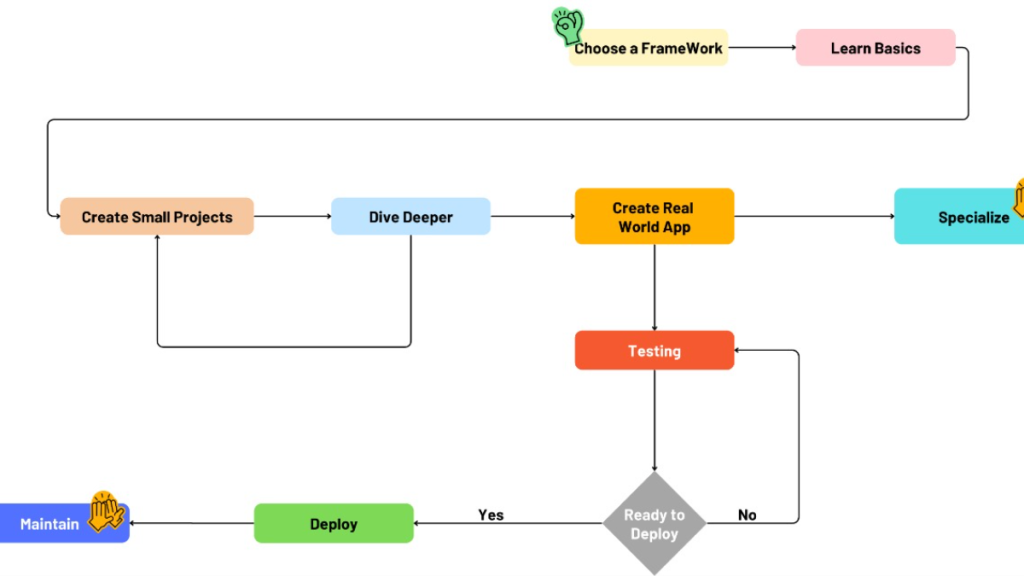
Step 4: Build Real Mobile App Projects
The best way to learn mobile development is by building real apps. Projects help you:
- Apply theoretical knowledge
- Understand real-world challenges
- Build a strong portfolio
Start with simple apps like:
- To-do list app
- Weather app
- Notes app
Then move to advanced projects like:
- E-commerce app
- Chat application
- Fitness tracker
Your portfolio is often more important than certifications.
Step 5: Learn APIs, Databases, and Backend Integration
Modern apps are rarely standalone; they rely on backend systems.
You should learn:
- REST APIs and JSON
- Authentication (OAuth, JWT)
- Databases (SQLite, Firebase, MongoDB)
- Cloud services
This knowledge allows your apps to handle real-time data and user interactions.
Step 6: Understand Mobile App UI/UX Principles
A successful app is not just functional; it must be user-friendly.
Focus on:
- Clean and intuitive design
- Responsive layouts
- Accessibility
- Performance optimization
Good UI/UX design improves user engagement and retention.
Step 7: Prepare for Mobile Developer Interviews
Once you’ve built skills and projects, the next step is landing a job.
Preparation should include:
- Practicing coding problems
- Revising Android/iOS fundamentals
- Understanding architecture patterns
- Mock interviews
You should also review common Android developer interview questions and system design concepts.
Common Mistakes New Mobile Developers Make
For mobile applications, functionality is insufficient on its own. An app’s success is mostly dependent on its seamless user experience and well-designed mobile application. Experts have noted that many mobile apps fail owing to design flaws that irritate users and induce early desertion rather than technical constraints.
Essential development principles are sometimes neglected as companies concentrate on creating feature-rich products. The most frequent errors made by mobile app developers are shown below, along with our suggested solutions.
Many beginners slow their progress by making avoidable mistakes:
- Skipping programming fundamentals
- Jumping between too many frameworks
- Not building real projects
- Ignoring UI/UX principles
- Avoiding debugging and testing
Consistency and focus are key to success.
You may also like: Mobile App Monetization: Strategies for Success
In Conclusion, Why Developers Must Change in 2026
The software industry is changing at a breakneck pace. Software engineering is more than just creating code, as AI, quantum computing, and cloud-native technology become commonplace. Nowadays, developers have to create inventive, scalable, and robust solutions that keep up with the rapid advancements in technology.
It is no longer sufficient to be proficient in a single language or framework. Today’s developers must think like product managers, security specialists, and mini-architects. The final result? Developers who can adapt to change rather than be destroyed by it are essential for teams.
Becoming a mobile developer in 2026 is more accessible than ever, but it requires discipline, consistency, and the right roadmap.
By following this step-by-step guide, from learning programming basics to building real-world projects, you can successfully transition into a career in mobile app development.
The key is simple: learn, build, and improve continuously.
Frequently Asked Questions
How long does it take to become a mobile developer?
Your learning speed, consistency, and past programming experience will determine how long it takes to become a mobile developer. Being prepared for the workforce often requires six to twelve months of concentrated study and practical experience. In order to improve their skills, beginners usually spend the first few months learning the principles of programming and mobile development.
Do I need a degree to become a mobile developer?
No, becoming a mobile developer does not require a formal degree. Many accomplished developers are self-taught and have developed their professions via boot camps, online courses, and real-world experience.
Should I learn Android, iOS, or cross-platform development first?
To establish a strong foundation in mobile programming, it is best to start with a single platform, either iOS or Android. You can gain a deeper understanding of fundamental ideas like UI design, app architecture, and performance optimization by mastering a single platform.
What projects should I build as a beginner mobile developer?
As a beginner, to gain an understanding of basic functionality and UI development, begin with simple projects such as a to-do list, notes app, calculator, or weather app. Go on to more complex projects like chat apps, e-commerce apps, or apps with real-time functionality, authentication, and APIs once you have gained confidence.